

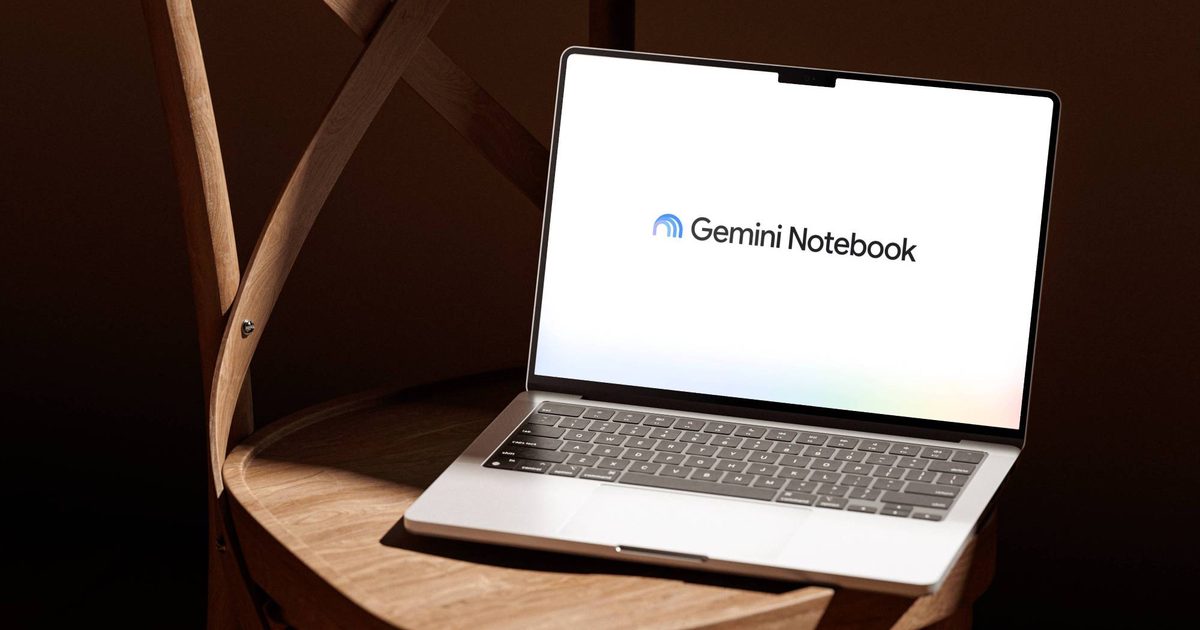
Google is officially retiring the NotebookLM name and rebranding its AI-powered research tool to Gemini Notebook. This change folds one of the company's most innovative and useful products deeper into its main AI brand, Gemini. Alongside the rebrand, Google is expanding one of the tool's most powerful features to a wider audience, moving it from the high-end Google AI Ultra plan down to the Pro tier.
The Upgrade Pro Users Have Been Waiting For
NotebookLM, now Gemini Notebook, received a major update last month that fundamentally changed how users interact with their uploaded material. Google gave every notebook a dedicated cloud computing environment capable of writing and executing code directly against a user's uploaded sources. This means researchers, analysts, and students can now run Python scripts, analyze data, and generate dynamic visualizations without leaving the notebook. The tool also moved onto a new reasoning engine, enhancing its ability to synthesize information and provide deeper insights. Most notably, the update expanded the range of outputs the tool can generate, including PDFs, spreadsheets, slide decks, and data visualizations. However, initially these capabilities were limited to Google AI Ultra subscribers and select Workspace business accounts, leaving many power users locked out.
With the Gemini Notebook rebrand, Google is now bringing that same upgraded experience to Google AI Pro subscribers. Over the coming weeks, Pro users will gain access to the cloud computing environment, code execution, and expanded output generation on the web version of Gemini Notebook. This is a significant move, as the Pro plan is more affordable and widely adopted than the Ultra tier, making advanced AI-assisted research accessible to a larger group of professionals, entrepreneurs, and content creators. Google has not yet announced when or if these features will reach users on the free tier, but the expansion to Pro signals a commitment to rolling out powerful capabilities to paying subscribers first.
Gemini Notebook Will Show Up in More Places Too
The new name is only one part of a larger integration strategy. Google is weaving Gemini Notebook deeper into its ecosystem, making it accessible from multiple entry points. Back in April 2025, Google expanded notebook access to the main Gemini app, allowing users to pull saved research and sources directly into a chat without switching contexts. This seamless flow between the notebook and conversational AI is a key differentiator, enabling users to start a research session in the notebook, ask follow-up questions in the Gemini app, and then return to the notebook with new findings.
Now, Google plans to make notebooks accessible through AI Mode in Search. AI Mode is Google's experimental search interface that provides conversational, synthesized answers instead of a list of links. By integrating Gemini Notebook, users will be able to access their personal research collections directly from search results, making it easier to cross-reference information. For example, if a user is researching climate change impacts on agriculture, they can ask a question in AI Mode and then pull up their curated notebook containing relevant papers and articles, all without leaving the search session. Google has not yet shared a timeline for when this feature will ship, but it represents a significant step toward an interconnected AI workspace.
The rebrand also reflects a broader shift in Google's product strategy. NotebookLM debuted at I/O 2023 under the codename Project Tailwind. It was initially positioned as an experimental tool for organizing and synthesizing user-uploaded documents. Over the course of two years, it evolved from a simple note-taking assistant into a sophisticated research platform capable of generating citations, summarizing complex texts, and even creating interactive audio discussions (the popular Audio Overviews feature). The transition to the Gemini brand is a natural progression, aligning the tool with Google's unified AI model family.
Historically, NotebookLM was one of the few Google products that operated under its own distinct identity while still using the company's underlying AI models. The rebrand to Gemini Notebook eliminates that separation. Users will now see a consistent branding across the Gemini app, Gemini Search, and Gemini Notebook. This consistency helps Google present a cohesive AI product line to consumers, businesses, and developers, reinforcing the Gemini brand as the central AI experience across the company.
The expansion of advanced features to Pro subscribers also has implications for the competitive landscape. Tools like Notion AI, ChatGPT's Canvas mode, and Microsoft's Copilot all offer AI-assisted research and content generation, but few provide the deep integration with user-uploaded documents and the ability to run code directly on those sources. Gemini Notebook now positions Google as a strong contender in the AI research assistant market, especially for users who need to analyze proprietary data, run simulations, or generate rich multi-format reports from a single interface.
For instance, a financial analyst could upload quarterly reports, use the notebook's code environment to run financial models, and then generate a slide deck summarizing the key findings—all within the same session. A student could upload lecture notes and textbooks, ask the notebook to create practice quizzes, and then export a PDF study guide. The ability to produce spreadsheets directly from analyzed data eliminates the need to switch between different tools, saving time and reducing friction.
The technical underpinnings of Gemini Notebook's upgrade are also worth examining. The dedicated cloud computing environment is likely powered by Google's Cloud TPUs and GPUs, allowing for real-time code execution and large-scale data processing. The new reasoning engine, which Google has not detailed, appears to be a more advanced version of its LLM that can better handle multi-step reasoning, source attribution, and comparative analysis. This is especially important for academic and professional users who need accurate, verifiable outputs.
As Google continues to integrate Gemini Notebook into Search and the Gemini app, the boundaries between search, research, and content creation will continue to blur. This vision of a unified AI workspace is something competitors are also pursuing, but Google's existing infrastructure—especially its search index and cloud services—gives it a unique advantage. The company can leverage its massive search data to pre-fill notebooks with relevant sources, or provide contextual suggestions based on a user's search history (with privacy safeguards).
The rebrand also affects how the tool is marketed and discovered. The name “NotebookLM” was memorable but somewhat cryptic. “Gemini Notebook” is more descriptive and clearly ties into the Gemini ecosystem, making it easier for users to find and understand the product. It also opens the door for cross-promotion within the Gemini app, which already has a large user base.
Looking ahead, further expansions are likely. Google may introduce team and enterprise versions that allow multiple users to collaborate on the same notebook in real time, or add integrations with Google Workspace apps like Docs and Sheets. The free tier may eventually get limited access to the new features, perhaps with usage caps to differentiate paid plans.
In summary, the rebrand of NotebookLM to Gemini Notebook is more than a name change—it represents a strategic shift to make advanced AI research capabilities more accessible and integrated across Google's product suite. By expanding the powerful update to Pro subscribers and planning deeper integration with Search and the Gemini app, Google is signaling that AI-powered research is a core component of its future vision. The move also intensifies competition in the AI assistant space, offering users a compelling alternative for managing, analyzing, and generating content from their own data.
Source: Digital Trends News