

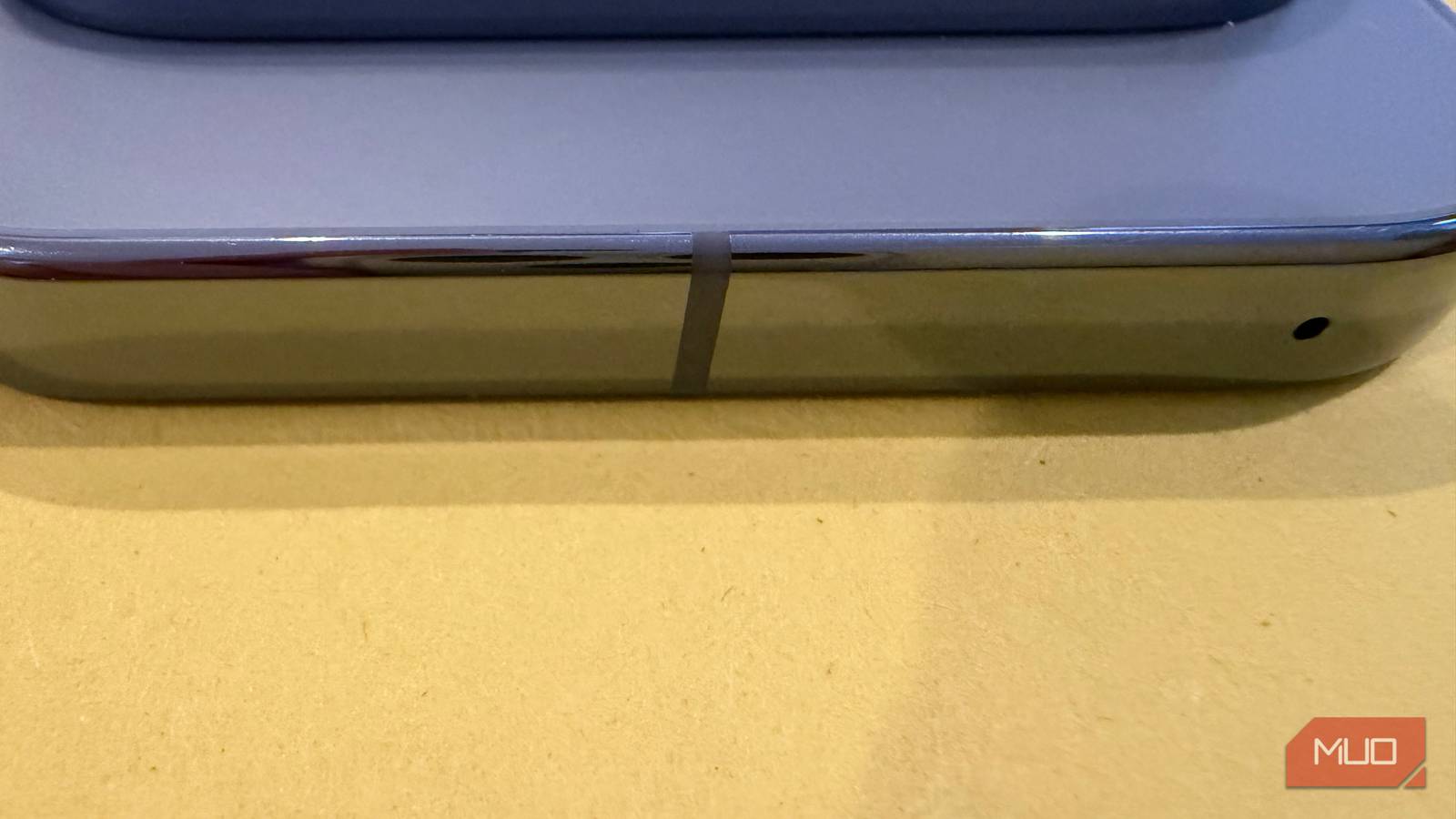
Have a look at your phone. Chances are, your phone has random lines integrated into the frame, perhaps on the side rails or along the back. You might even notice an oval-shaped cutout that looks similar to a fingerprint scanner, but it's not. These features are present on virtually every modern smartphone, from budget models to premium flagships. They aren't for looks — honestly, they're kind of ugly. They exist to solve an engineering problem every device maker has faced since phones moved to metal unibody construction.
What Are These Weird Lines and Cutouts on My Phone?
They're Not a Design Choice, They Are a Forced Compromise
Older phones, such as the metal HTC One M7 from 2013 (when HTC used to make groundbreaking phones), awkwardly placed these lines on the back of the phone as a divider between various components of the phone. The lines were thick, visible, and interrupted the otherwise sleek metal surface. Later, manufacturers figured out how to place these lines along the edges of the phone, allowing the back to be a clean surface with no interruptions, as you can see on many modern devices like the Samsung Galaxy S22 or the iPhone Air. The lines are actually plastic or composite material that acts as a window for radio waves.
The Problem: Metal Is the Enemy
Metal Blocks Wireless Signals
Before we made the switch to metal, most phones were made of plastic, which was lightweight and durable, and critically did not interfere with the transmission of wireless signals. Plastic is radio-transparent, meaning cellular, Wi-Fi, Bluetooth, and GPS signals can pass through it with minimal attenuation. In the early 2010s, phone manufacturers made the move to metal unibody phones, often cut out of a solid block of aluminum. This move to metal served multiple purposes. First, it looked and felt premium. Metal has a timeless quality. It reflects the light beautifully. It's cool to the touch. Metal phones from this era felt like precise jewelry (does anyone remember the shiny chamfered edges we got for a few years on some flagship phones?), versus the cheap feel of plastic phones that often had a greasy, shiny finish that picked up fingerprints and felt low quality.
Second: heat. The enemy of most devices, especially small ones that are unable to have active cooling (like with a fan that you'd find on a PC or with passive cooling materials like liquid metal), means that heat has a hard time escaping phones. That causes the processor to slow down, it accelerates battery drain, and it's bad for the longevity of the phone's components. The move to metal means that the entire phone can act as a heat sink, since metals like aluminum are excellent conductors. This allowed manufacturers to pack more powerful processors into thinner bodies without thermal throttling.
Third: structural rigidity and tighter tolerances. As phones got bigger but with thinner profiles, plastic just couldn't keep up with the industrial design demands of the modern consumer that wants a precise, premium, yet thin device. A precision Computer Numerical Control (CNC) machine can precisely carve a phone out of a single piece of aerospace-grade aluminum, allowing it to produce a phone with impossibly thin side rails while offering extremely high structural rigidity. This also allowed for tighter manufacturing tolerances, meaning less creaking or flexing when the phone was subjected to stress.
But these metal phones also presented an engineering challenge: how would the wireless signals, whether cellular, Bluetooth, Wi-Fi or GPS, escape the phone? A metal phone is essentially a faraday cage (an enclosure that blocks electromagnetic fields), which is a major problem for a phone. Without a way for signals to get out, the phone would be unable to make calls, connect to the internet, or use location services. Engineers had to devise a solution that preserved the metal appearance while allowing radio waves to pass through.
The Solution: Plastic/Composite Lines or Glass Windows Allow Wireless Signals Through
Either through these lines you see, or through a glass cutout, like you'll find on the latest pro iPhones or in the "visor" present on most Pixel devices, manufacturers have created openings for wireless signals to pass through. The lines are typically made of a polycarbonate or other plastic composite that is radio-transparent. They are inserted into grooves cut into the metal frame and then painted to match the surrounding metal, although they often have a slightly different texture or sheen. A secondary benefit to phones that have a glass cutout on the back, or that use glass panels on the entire back that actually look and feel like metal (as is often the case on Samsung phones), is that wireless charging still works as no fully metal phone could have wireless charging. This design evolution has led to the widespread adoption of the "glass sandwich" design, where the front and back are glass, and the frame remains metal. This provides the best of both worlds: premium feel on the edges and unobstructed radio signal transmission through the glass panels.
What About That New Large Oval on Phones?
That's Your mmWave 5G Antenna Cutout
On some devices, you might have noticed this oval cutout along the edge of the phone which looks kind of like a fingerprint sensor. This is your mmWave 5G antenna cutout, designed for the ultra-rare, and almost non-existent flavor of 5G that was supposed to bring us gigabit-level speed and latency in certain situations. mmWave (millimeter wave) uses very high frequency radio waves that can carry massive amounts of data but have extremely short range and are easily blocked by obstacles like buildings, trees, or even a user's hand. To make matters worse, mmWave signals are easily absorbed by the metal frame of a phone, so a dedicated cutout with a special transparent material is needed for the antenna to function.
But chances are your phone has never had to use this antenna, and probably never will: mmWave networks are rare (except in certain densely populated areas), and you've probably never been on one, because they're very expensive, the signals only go short distances and using mmWave uses a tremendous amount of battery. The lack of mmWave networks makes the antenna lines on your phone even more important, which makes it possible for your phone to use low and midband 5G (as well as 4G/LTE). The oval cutout remains a physical reminder of the early 5G hype, and many carriers have since scaled back their mmWave deployments.
Those Lines on Your Phone Aren't for Looks
They're a Critical Part of the Wireless Radio System
Now you know what those lines actually do. They are not cosmetic imperfections; they are carefully engineered features that enable your phone to communicate with the world. Without them, your phone would be a beautiful but useless brick. This is why most devices today have adopted the "glass sandwich" where the front and back of the phone are glass, but the frame and side rails are still rigid, premium metal. This simultaneously lets all the wireless signals permeate the phone, while keeping a premium metal feel exactly where your hands touch the phone — the edges. The evolution from plastic to metal to glass has been driven by a constant trade-off between aesthetics, durability, and functionality. Future phones may move to ceramic or other materials, but for now, these lines are an integral part of your device's design, serving a purpose far beyond what meets the eye. Understanding them gives you a deeper appreciation for the engineering marvel that is your smartphone.
Source: MakeUseOf News