

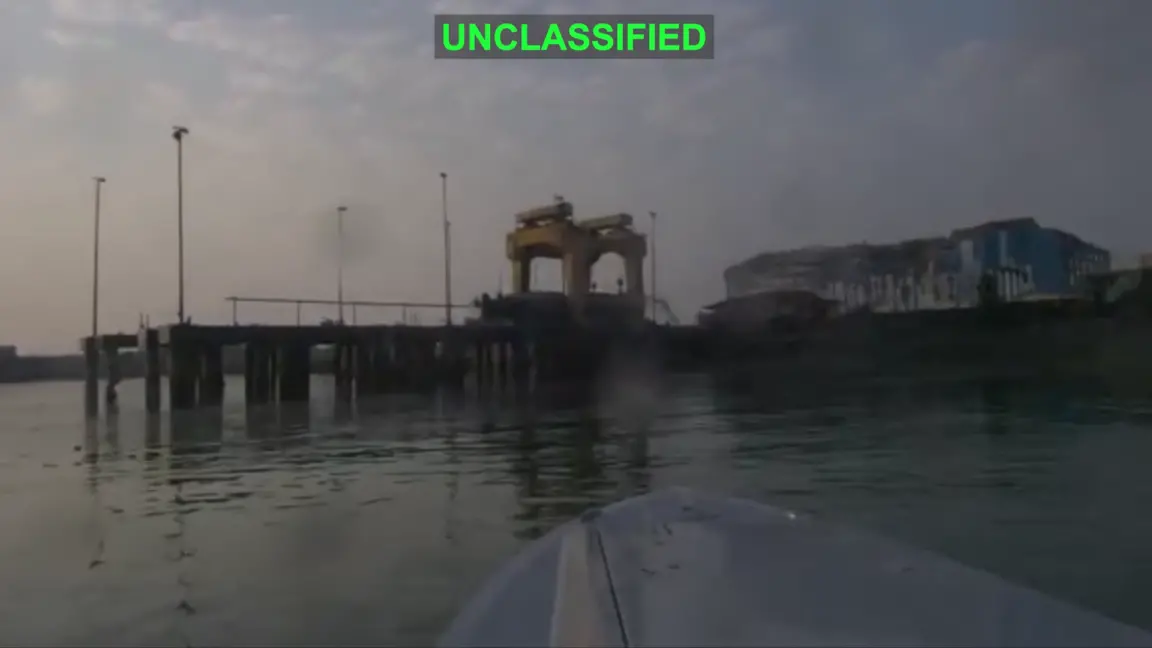
For the first time in its history, the US military has used explosive-laden unmanned surface vessels in combat. The attack targeted an Iranian midget submarine and a naval maintenance facility at Iran's Bandar Abbas Naval Base on the night of July 12. The operation marks a major milestone in the Pentagon's shift toward inexpensive, reusable and expendable maritime drones.
The US military released video showing three "one-way attack surface drones" exploding after approaching the submarine and ship maintenance facility. US Central Command, which oversees Middle East operations, described the strikes as the "first time American forces have employed sea drones in combat operations." According to USNI News, the boats were able to make a low-speed, uncontested approach to their targets before detonating. One target was identified as an Iranian Ghadir-class midget submarine that was out of the water and suspended from a gantry.
New technology, familiar role
The drone boats used in the strike are Saronic Corsair autonomous surface vessels, built by Saronic Technologies, a defense company based in Austin, Texas. The company says the Corsair is 24 feet long and can carry up to 1,000 pounds over a range of 1,000 nautical miles, with a top speed above 34 knots. A company blog says the vessel can operate autonomously without direct human control, including long-range navigation, patrol missions, and regulation of power consumption and engine use to loiter at a fixed position. For the strike, the boats were likely equipped with explosive warheads.
The Corsair is part of a broader US effort to acquire small, relatively inexpensive unmanned maritime systems. The Navy and Special Operations command have tested various drone boats in exercises for years, but until now no American sea drone had ever been used to attack an enemy target. The July 12 operation therefore represents a doctrinal change, moving beyond surveillance, mine countermeasures, and force protection into offensive strike.
The video footage, though brief, shows the boats approaching Iranian targets in darkness before disappearing in a blast. The low-speed approach suggests the boats were either mistaken for harmless objects or were able to evade base defenses. Naval analysts have long warned that such vessels could overwhelm expensive warships and shore installations by exploiting gaps in radar and visual detection. The US strike appears to confirm that offensive sea drones can reach targets without sustaining defensive fire.
Five years after the Houthis changed naval warfare
The United States is a late entrant into the world of kamikaze drone boats. The first confirmed use of an explosive uncrewed surface vessel occurred on January 30, 2017, when Yemen's Houthi movement struck the Royal Saudi Navy frigate Al Madinah with a remote-controlled boat. A US Navy commander told Defense News at the time that the weapon was likely developed with technical assistance from Iran, which had long supplied the Houthis with weapons and expertise. That attack set the template for the drone boat as an asymmetric weapon: cheap, hard to detect, and able to strike a high-value target at a fraction of the cost of traditional munitions.
In the years since, the Houthis and Iran have expanded their use of unmanned maritime systems. The Iranian military has displayed various attack drone boats, including some designed for swarming tactics in the Persian Gulf. Iranian-backed forces have used such weapons to threaten tankers and naval vessels, forcing the US Navy to adjust its own tactics and develop countermeasures.
Ukraine's drone navy
The most dramatic development in drone boat warfare has come from Ukraine. After Russia launched its full-scale invasion in February 2022, Ukraine, lacking a conventional navy, built a fleet of explosive unmanned surface vessels. Ukrainian Magura V5 and Sea Baby drones have struck Russian warships, patrol boats, and tankers. The campaign forced Russia to withdraw major Black Sea Fleet assets from Sevastopol to bases farther from Ukrainian-controlled territory, a strategic setback made possible almost entirely by drone boats.
Ukraine has also used drone boats in groundbreaking ways. Ukrainian crews fitted small air-defense missiles to unmanned boats and used them to shoot down Russian helicopters. In other operations, Ukrainian sea drones carried small aerial drones that took off and struck Russian radar and air defense systems positioned near the coast. Most recently, a Ukrainian drone boat delivered an armed ground robot onto contested coastal territory in what was described as an unprecedented amphibious operation. These battles have demonstrated that small, uncrewed platforms can perform missions previously reserved for large crews and expensive vessels.
The US strike on Bandar Abbas borrows directly from those lessons. American defense planners have watched the Ukrainian experience closely. The decision to use Corsair boats in an offensive role suggests that the Pentagon is now applying those lessons in high-intensity conflict, not just in development laboratories.
From rescue missions to combat strikes
The July 12 attack was not the first wartime use of a Corsair drone by American forces. On June 8, a Corsair rescued two US Army helicopter pilots in waters off Oman after their AH-64 Apache was shot down by an Iranian Shahed drone. That rescue mission showcased the boats' ability to operate autonomously and recover personnel, a mission that previously would have required a helicopter or a manned surface vessel. The same platform now has demonstrated an offensive capability.
The Corsair is one of several small autonomous vessels purchased by the US military in recent years. Rapid advances in computing, navigation, satellite communications, and machine learning have made it possible to operate large numbers of unmanned boats without pilots onboard. This has created new opportunities for "distributed" naval operations, in which hundreds of cheap drones can saturate defenses.
At the same time, the US military has begun using LUCAS drones, one-way attack aerial systems based in large part on Iranian-designed Shahed drones. The war against Iran has accelerated the Pentagon's shift toward expendable systems, particularly after the loss of dozens of expensive MQ-9 Reaper drones, with a combined value exceeding $1 billion. The Reaper was designed for long-duration surveillance and precision strikes, but its cost and vulnerability made it less viable in a contested, drone-heavy environment.
Cheaper weapons are not necessarily better in every case, but they change the economics of war. A $500,000 sea drone that can strike a naval base or sink a warship presents a difficult cost-exchange problem: defending against it may require missiles that cost far more, or the diversion of ships and aircraft that are already in high demand.
Collapse of the ceasefire and renewed escalation
The US drone boat strike took place during a renewed American campaign against Iran. A ceasefire that had briefly slowed fighting collapsed, and President Donald Trump ordered a new wave of strikes. The attack at Bandar Abbas occurred alongside strikes by conventional fighter aircraft and warships against Iranian targets in recent days. The introduction of drone boats is likely aimed at demonstrating that the US military can strike Iranian facilities without exposing risky manned assets near shore.
Bandar Abbas is strategically important because it sits on the Strait of Hormuz, through which a large share of the world's oil and gas passes. Iran has stationed naval forces there, including midget submarines and fast attack craft. The July 12 attack was designed to degrade Iran's ability to disrupt shipping routes and threaten allied vessels.
The use of sea drones in combat is still new, and their long-term tactical and strategic effects are uncertain. But the July 12 attack marks a clear turning point. A technology that was once the preserve of nonstate groups and smaller navies has now been embraced by the world's largest military. The result could reshape how future naval wars are fought, particularly in crowded and contested waters where unmanned systems can operate at low cost and with low risk to human crews.
The American military has not said exactly how many Corsair boats were launched, how they were controlled, or whether they were recovered after the mission. The three drones shown in the video exploded, suggesting the strike was planned as a one-way attack. Whether the US military will continue using drone boats in this way likely depends on how effective the strike proved to be and whether Iran adjusts its defenses to stop such approaches in the future.
For now, the milestone is clear. The US military has crossed a threshold by using explosive drone boats in combat, following a path first shown by Houthi forces in 2017 and later refined by Ukraine. The boats may be small, but their first combat use signals a fundamental change in American naval warfare.
Source: Ars Technica News