

Introduction
The Bundesliga, Germany's premier professional soccer league, has long championed the idea of turning "data into devotion." With the launch of its new AI companion called Captain, embedded directly into the official league app, that vision has become a reality. Captain is an agentic AI assistant that lets fans interact using natural language to access live statistics, historical match data, tactical analysis, trivia, and personalized video highlights—all without leaving the app. For IT professionals, this is far more than an innovative sports-tech use case. It represents an early blueprint for how generative and agentic AI can transform customer experience across industries. By examining Captain's architecture, data foundation, and strategic implications, we can extract valuable lessons for building AI-native customer engagement platforms.
Understanding Captain: A Conversational Companion
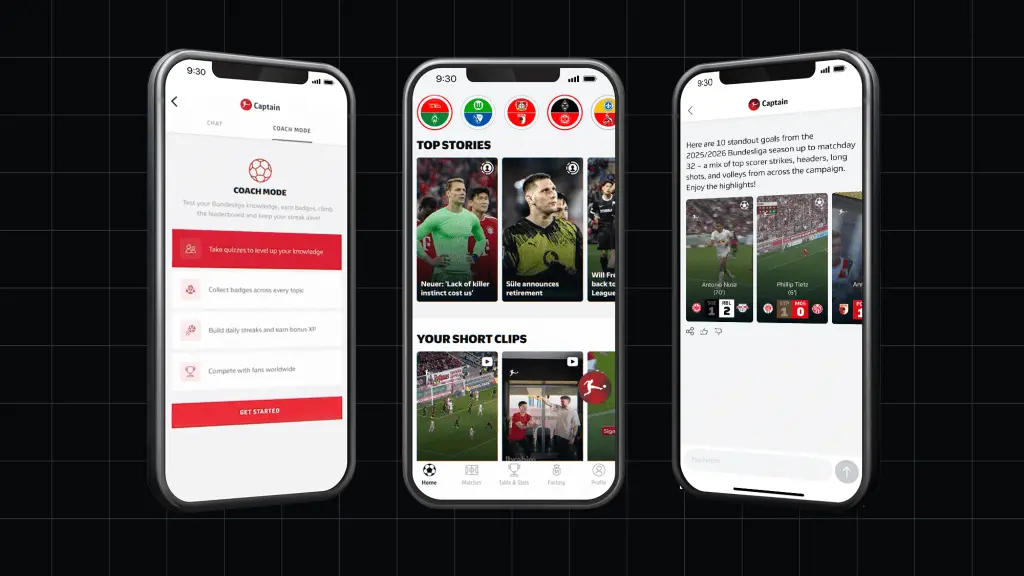
Captain acts as a knowledgeable friend who watches every game alongside the fan. Users can ask complex questions such as, "How has Jamal Musiala been performing for Bayern Munich this season compared to his appearances for the German national team?" The AI responds with answers grounded in official league data, complete with relevant stats, historical context, and video clips. Key capabilities include on-demand access to live statistics, historical match data, tactical analysis, trivia, and video highlights via chat. Additionally, Captain proactively surfaces insights during major events like goals, penalties, and milestones, identifying streaks, records, or parallels to historic games. A "coach mode" gamifies learning the sport by adapting explanations and daily lessons to each fan's knowledge level.
Technical Architecture: Multi-Agent AI on AWS
Under the hood, Captain leverages a multi-agent architecture built on Amazon Bedrock and Amazon Nova. The system dynamically routes each request to the most appropriate model and workflow. Simple questions are handled by lightweight models, while complex reasoning and data mashups are directed to more capable models. Natural language queries are translated into SQL via text-to-SQL pipelines, enabling real-time querying of the Bundesliga's analytics stack. A router agent determines intent, stats agents query backend systems, and research agents autonomously investigate events and propose stories. This modular design moves beyond a single large language model (LLM) to an orchestrated system where components can evolve independently.
The Data Foundation: From 3.6 Million to 200 Million Data Points Per Match
The true innovation behind Captain is not just the conversational interface but the sophisticated data infrastructure required to deliver real-time, accurate responses. Historically, the Bundesliga tracked one data point per player per second, generating roughly 3.6 million data points per match. With the adoption of 3D skeletal tracking—capturing 21 points per player at 50 frames per second—they now process approximately 200 million data points per match. This massive influx of data flows into a modern analytics and AI stack on AWS. The stack includes streaming ingestion via Amazon MSK, a data lake and lakehouse foundation using S3 Tables and Apache Iceberg, query and analytics through Amazon Athena with text-to-SQL workflows, and vector stores that cache question-to-SQL patterns to reduce costs on repeated queries.
On top of this foundation, a set of agentic workflows continuously monitors live events, generates candidate "stories," and pushes the best ones into Captain. The same infrastructure already powers thousands of AI-generated narratives per season for broadcasters and editors, demonstrating how editorial and fan experiences can share a common AI backbone. For IT leaders, the key takeaway is clear: data strategy is as important as model selection in building compelling generative AI experiences.
What This Signals About the Future of Customer Experience
Captain illustrates several important shifts that will define AI-driven CX across industries. First, apps are evolving into companions. Instead of forcing users to navigate menus and features, the Bundesliga consolidates multiple use cases—scores, stats, historical research, video discovery, and learning—into a single conversational surface. Enterprises will replicate this pattern with "digital relationship managers" in banking, "patient companions" in healthcare, and "shopping concierges" in retail. Second, the focus shifts from reactive support to proactive storytelling. Most chatbots simply answer questions; Captain also looks ahead. When a major event occurs, agentic workflows autonomously find interesting angles—a broken record, a rare streak, a historical déjà vu—and push them to fans in real time. Imagine similar patterns in other domains: an insurance AI flagging a better coverage option at renewal, or a B2B vendor surfacing adoption risks before a renewal conversation.
Third, experiences become adaptive. Coach Mode exemplifies progressive disclosure, teaching new fans the rules while offering tactical deep dives for advanced fans—all within the same interface. Enterprises will need systems that can explain a process to a novice and to a domain expert in different ways without duplicating apps or content. Fourth, static journeys are evolving into AI-driven micro-journeys. The Bundesliga uses agentic AI to stitch together micro-journeys in real time: a question triggers an answer, a research agent follows up with deeper content, a video agent suggests highlights—all personalized and sequenced. In enterprise CX, journeys will increasingly be orchestrated by AI that adapts steps, channels, and content to context, rather than by rigid workflows.
Implications for IT Pros and CX Leaders
1. Start with a Data-First Mindset
Captain only works because the Bundesliga invested years in building a robust data foundation: high-fidelity tracking, consistent schemas, and streaming infrastructure. Before promising AI companions to business stakeholders, IT teams should inventory customer data sources and identify gaps in coverage, latency, and quality. They must rationalize schemas and metadata so AI agents can reason across systems (CRM, transactional systems, content libraries) without brittle transformations. They should also plan for real-time or near-real-time data where "moment of truth" interactions matter. Without this groundwork, generative AI projects risk turning into expensive prototypes that cannot scale.
2. Think in Terms of AI Agents, Not Just Models
Bundesliga’s architecture separates concerns into agents: a router agent for intent determination, stats agents for backend queries, and research agents for autonomous investigation. IT teams should similarly design routing layers that classify requests as informational, transactional, or analytical; develop specialized agents for data retrieval, verification, personalization, and safety; and establish clear SLAs and guardrails for agent interactions with core systems. This moves the organization from a monolithic LLM to a modular, orchestrated system where components can evolve independently.
3. Leverage Dynamic Routing for Cost and Performance
Bundesliga explicitly uses dynamic model routing, relying on lighter models for simple queries and more powerful ones for complex reasoning. This approach cut chat costs by more than a third without sacrificing accuracy. Enterprise IT can adopt similar patterns: use smaller models or retrieval-plus-templating for repeatable queries; reserve premium models for complex, high-value interactions; and continuously analyze query types to refine routing policies. The result is an AI experience that scales economically rather than collapsing under inference costs.
4. Redefine UX Around Conversation and Context
Captain’s UX is not just chat—it is chat tightly coupled with video playback, stats visualization, and contextual recommendations. For IT and product teams, this means designing conversational experiences that can invoke micro-apps or widgets (e.g., forms, dashboards, media players) in context. It requires maintaining conversation state across channels, so a user can move from mobile to web or from chat to voice without losing context. It also involves instrumenting these flows to understand where AI helps, confuses, or frustrates users. Generative AI should be treated as a new interaction layer, not a standalone feature.
5. Treat Safety and Trust as First-Class Requirements
Captain is built on official league data and protected by content safety guardrails to prevent hallucinations or inappropriate content. In enterprise settings, this translates to strict grounding of AI outputs in trusted systems of record; fine-grained access controls so agents only see what they should; and human-in-the-loop workflows for high-risk outputs such as financial advice, medical suggestions, or legal communications. Trust will be the differentiator between AI experiences that delight and those that harm brand equity.
How IT Pros Should Think About Next Steps
For most organizations, the Bundesliga’s Captain should be viewed as aspirational but achievable. Practically, IT pros can start by identifying one high-value, data-rich customer journey—such as onboarding, troubleshooting, or order tracking—as a pilot. They can stand up a modest but modern data foundation for that journey, including event streaming and a unified view of context. Then they can prototype an AI companion that combines retrieval-augmented generation with a couple of simple agents for routing and follow-ups. Finally, they should instrument everything—latency, cost, satisfaction, containment—to build the business case for expanding to more journeys. The Bundesliga shows what happens when an organization treats AI not as a feature but as a new way to connect with fans. IT leaders who treat generative and agentic AI as central to their customer experience strategy will be the ones who turn their own data into genuine customer devotion.
Source: Network World News