

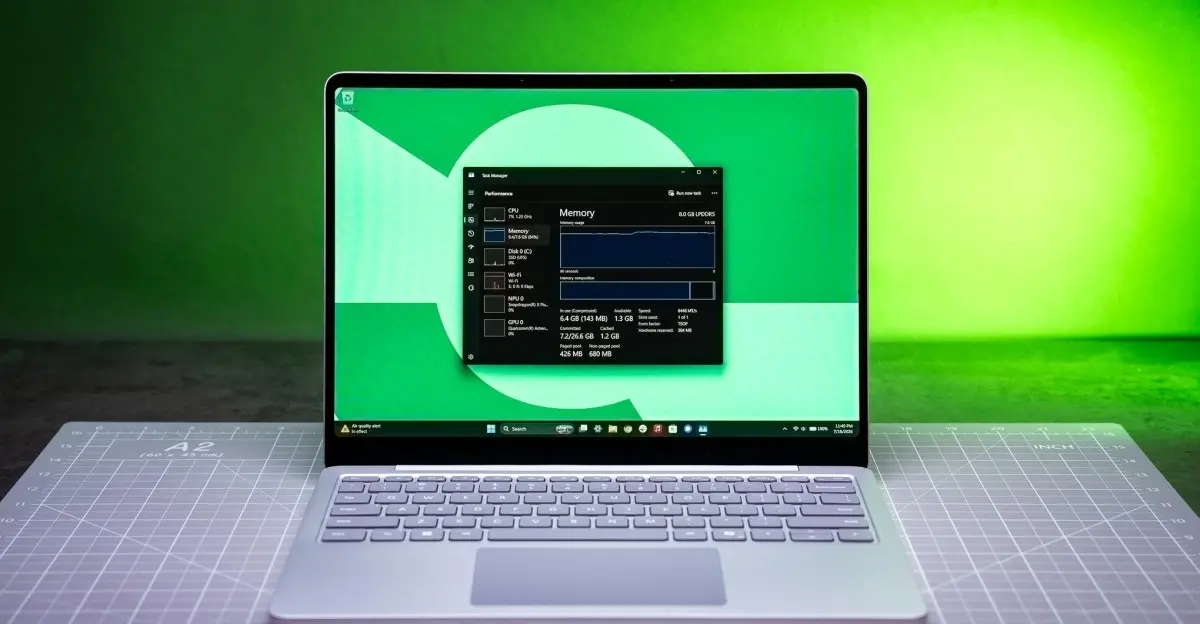
Last year, Microsoft’s 13-inch Surface Laptop was praised as one of the best thin-and-light Windows notebooks, offering MacBook Air–like build quality and battery life at a reasonable $900. This year, however, the same laptop costs $950 and comes with half the RAM—just 8GB. It is the same great hardware on the outside, but inside, it is a different story.
The global RAM shortage, dubbed "RAMageddon," has pushed memory prices higher, leading manufacturers to cut costs by reducing memory in entry-level devices. Microsoft’s Surface Laptop is the most prominent example, but Dell, Acer, and Asus have also announced upcoming laptops with 8GB of RAM. This marks a worrying trend for Windows users, as 8GB has been considered insufficient for several years.
The Verge tested the 2026 Surface Laptop with 8GB of RAM, running a Qualcomm Snapdragon X Plus processor and 256GB of storage. While the hardware remains excellent—great keyboard, trackpad, webcam, and battery life—the performance is hampered by the lack of memory. Although the laptop handles basic web browsing and video streaming adequately, it struggles with moderate multitasking. For instance, a Microsoft Teams call with a video stream caused the entire system to hang for several seconds, even with only about 10 Chrome tabs open across two desktops alongside Slack and Signal.
Such freezes occurred multiple times a day during testing, even when the user thought they were not pushing the laptop hard. Task Manager showed memory usage consistently around 6.7GB out of the available 7.6GB. After a fresh reboot, Windows 11 used 4.2GB of RAM alone, leaving very little headroom for applications. The reviewer noted that limiting themselves to about six Chrome tabs and closing background apps brought usage down to 5.5GB—but this is an inconvenient way to use a new $950 laptop.
Microsoft has claimed to focus on improving Windows 11 performance for lower-cost hardware, but this test shows that 8GB is still not enough. Interestingly, the MacBook Neo, which also has 8GB of RAM, handled similar multitasking better, possibly due to macOS’s more efficient memory management. The Neo also costs $250 less than the Surface Laptop.
The RAM shortage is expected to last years, meaning more 8GB laptops will appear. But if even Microsoft cannot make Windows 11 run well on 8GB, other OEMs face an even tougher challenge. The only solution for consumers is to spend more for 16GB models—like the same Surface Laptop at $1,150—or look for refurbished devices. The alternative is to switch to Apple’s MacBook Neo, which offers a better experience at a lower price.
This situation highlights a broader problem: the industry’s shift back to 8GB as a starting point for Windows laptops is a step backward. Windows 11 itself is memory-hungry, and with modern applications like Chromium-based browsers and collaboration tools demanding more RAM, users are left with little headroom. The Surface Laptop’s benchmark scores show that while the CPU performance is decent, the lack of RAM drags down real-world usability. In Geekbench 6, the 8GB model scored 2348 single-core and 9421 multi-core, similar to last year’s 16GB model, but multitasking tests like PugetBench for Photoshop crashed entirely.
The RAM crisis is not limited to Microsoft. Nvidia’s largest RAM supplier recently had a trillion-dollar market debut, and PC shipments have fallen for the first time in over two years due to high memory prices. Meanwhile, Apple continues to sell its MacBook Air with 8GB RAM, but its unified memory architecture and optimized software provide better performance.
The Verge’s review concludes that while the Surface Laptop’s hardware is still top-notch, the 8GB configuration is a poor value. The laptop scores a 6 out of 10, with the low RAM count being its biggest flaw. As the industry moves toward more AI features and larger operating systems, 8GB is no longer sufficient for a smooth Windows experience. Consumers are advised to avoid entry-level Windows laptops with 8GB RAM and instead invest in 16GB models or consider alternatives.
Source: The Verge News