

Handheld gaming systems aren't niche anymore. Today's devices span compact retro emulation machines, streaming-focused portables, and full-fledged portable PCs capable of running modern AAA games. That range is exciting but also makes shopping harder. The best gaming handheld for 2026 depends less on a single standout product and more on how, where, and what you want to play. Some handhelds are built for quick sessions and classic libraries, valuing simplicity, long battery life, and pocket-friendly designs. Others blur the line between console and PC, offering large screens, powerful processors, and access to huge game libraries at the cost of size, price, or endurance.
Our team has spent months testing these devices across multiple generations of hardware. The market keeps moving quickly, with new models appearing from both established brands and smaller Chinese companies. Still, several clear recommendations have emerged. Whether you want a versatile handheld for modern PC games, a premium Windows device, an Android machine for retro emulation, or a dedicated Game Boy-style portable, these are the gaming handhelds that stand out in an increasingly crowded field.
Steam Deck: Best handheld gaming PC for most
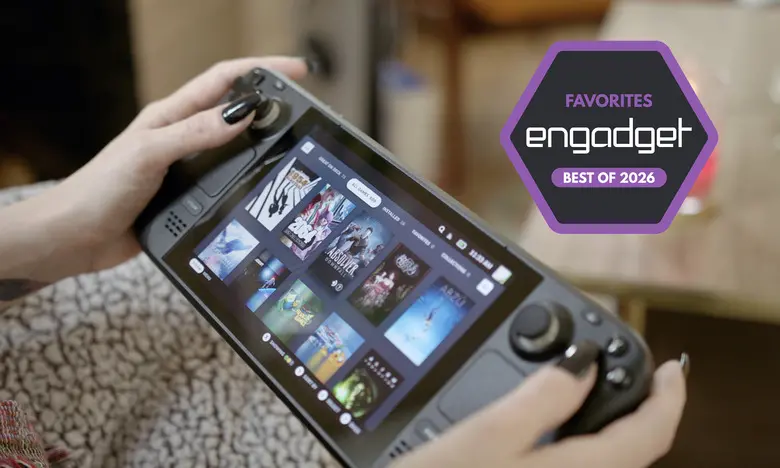
Valve's Steam Deck remains the best balance of price, performance, and usability in the gaming handheld market. The Steam Deck OLED starts at $549 for 512GB of storage and remains a thorough upgrade over the original model. Its 7.4-inch HDR OLED display is brighter, faster, slightly larger, and far more vivid than the 7-inch IPS panel on the entry-level Steam Deck. HDR support, a 90Hz refresh rate, and rich contrast make games look better by default. The OLED model also lasts longer thanks to a more power-efficient display, a newer AMD APU, and a larger 50Whr battery. Valve rates it for roughly three to twelve hours of play depending on the workload, while the original LCD model lasts between two and eight hours.
The entry-level Steam Deck often sells for $399 with a 256GB SSD. It has a simpler 60Hz LCD, older AMD silicon, and a smaller 40Whr battery, but it provides the same core experience at a significantly lower price. That makes the LCD Deck the best budget portable gaming PC available. To be clear, both Steam Deck models are showing their age in 2026. The most graphically demanding games released over the last couple years often struggle on this hardware, and Linux anti-cheat issues still make some live-service games unplayable. However, the Deck can play a massive chunk of the Steam library, including titles like Elden Ring, Final Fantasy VII Rebirth, and Balatro. Valve's SteamOS has also matured into a flexible, user-friendly platform.
The Steam Deck is excellent for emulation as well. With tools like EmuDeck, it can handle everything from 8-bit classics through many PlayStation 2 and GameCube games, plus some PlayStation 3 and original Xbox titles with patience. Its biggest downside is physical size: it is nearly a foot long, thick, and heavy compared to mobile handhelds. The LCD model can get warm and noisy, and the d-pad on both versions is a little soft. Still, the comfortable grips, responsive face buttons, and useful dual touchpads make it easy to live with. The OLED model's improvements to weight, display, fan noise, and battery life make it the version most people should buy if they can afford the extra cost.
Lenovo Legion Go S: Best premium handheld gaming PC
The Lenovo Legion Go S with SteamOS is the closest thing we have to a Steam Deck 2. It is the first third-party handheld to run Valve's operating system natively, so it includes the same user-friendly interface and occasional compatibility quirks as the Steam Deck. The Z1 Extreme version costs $900 and comes with an AMD Ryzen Z1 Extreme processor, 32GB of RAM, and a 1TB SSD. It can draw up to 33W in handheld mode and 40W when plugged in, well above the Steam Deck's 15W. This extra power makes it noticeably better for recent AAA games, offering higher frame rates and more room to increase graphical settings.
The Legion Go S also has an 8-inch IPS display with a 1,920 by 1,200 resolution, a 120Hz refresh rate, and variable refresh rate support. The larger screen is great for modern games, and VRR helps reduce distracting screen tearing. However, it is an LCD panel, so colors are not as rich as the Steam Deck OLED, there is no HDR, and peak brightness is lower at 500 nits. The device is a bit chunkier and heavier than the Steam Deck, but its rounded edges and textured grips feel comfortable, and the offset joysticks will feel familiar to many console players. Hall effect joysticks, dual USB-C ports, and a 55.5Whr battery are welcome features, though the battery often drains faster than the Steam Deck under heavy load. The fans also get loud under load. There is a cheaper $650 configuration with a Ryzen Z2 Go chip, 16GB of RAM, and 512GB of storage, but we have not fully tested it. For anyone who wants SteamOS with modern hardware, the Legion Go S is the strongest premium option.
ASUS ROG Xbox Ally X: Best Windows gaming handheld
If you want maximum software flexibility, the $999 ASUS ROG Xbox Ally X is the best Windows-based gaming handheld. Microsoft markets it as a handheld Xbox, but it is really a portable Windows 11 PC. It cannot play actual Xbox console games, and it does not use the same user interface as an Xbox console. Instead, it ships with a new Xbox full-screen experience, which is essentially a customized version of the Xbox PC app. That interface organizes games from multiple storefronts, reduces background tasks, and makes navigation easier with a gamepad. You can still access the full Windows desktop whenever you need it.
The hardware includes an AMD Ryzen Z2 Extreme processor, 24GB of RAM, a 1TB SSD, and a massive 80Whr battery. The 7-inch 1080p LCD display runs at 120Hz and supports VRR, which keeps gameplay smooth even when frame rates fluctuate. It is not as color-rich as the Steam Deck OLED, but the higher resolution and VRR are meaningful advantages. The ROG Xbox Ally X is also more powerful than the Steam Deck, especially when using the higher power modes. It can be pushed to 35W when plugged in, making it much more capable with demanding AAA games. Windows also means you can play games from Steam, Epic Games Store, GOG, Xbox Game Pass, and other PC clients without workarounds. That flexibility is a major reason to choose this device over a SteamOS handheld.
Battery life is better than most Windows handhelds, lasting around three and a half hours in a demanding game with brightness maxed out. The grips are comfortable, the buttons feel tight, and the speakers are loud. The downsides are familiar: Windows 11 still feels clunky on handhelds at times, the haptics are weak, and the device is expensive. It is also a bit bulky, though no more than the Steam Deck. A lower-cost version without the X branding costs $600, but it has a weaker Ryzen Z2 A chip, less RAM, less storage, and a smaller battery, making it a questionable value. For buyers willing to tolerate occasional Windows quirks in exchange for access to every PC storefront, the ROG Xbox Ally X is the best choice.
Retroid Pocket 5: Best mobile gaming handheld for most
The Retroid Pocket 5 is the best mobile gaming handheld for most people who want to emulate older consoles. Priced at $219, it runs Android 13 on a Qualcomm Snapdragon 865 processor with 8GB of RAM, 128GB of storage, and a 5.5-inch 1080p OLED display. It is far less powerful than portable PCs, so it is not meant for modern PC games. However, it can stream games from Xbox Cloud Gaming or other services, play native Android titles, and handle emulation up to most PlayStation 2 and GameCube games with the right settings. In testing, demanding PS2 games like Gran Turismo 4 and Ratchet and Clank ran at full speed with increased internal resolution. GameCube games like Super Mario Sunshine and F-Zero GX also ran well. Older systems such as PSP, Dreamcast, PS1, N64, and SNES are even easier.
Android emulation requires a lot of tinkering. You need to source ROM files, configure emulators, map controls, and sometimes install third-party GPU drivers. Some games still do not run perfectly. The Retroid Pocket 5's OLED display is excellent, and the hardware feels sturdier than many budget emulation handhelds. Its textured grips, responsive face buttons, firm d-pad, and Hall effect joysticks all make it comfortable for long sessions. The main design complaint is the joystick layout, which places the left stick below the d-pad and can make modern games feel awkward. Battery life ranges from three hours with demanding Android games to more than ten hours with older 8-bit and 16-bit systems. The Retroid Pocket Flip 2, priced at $229, offers the same internals in a clamshell body. It is more portable and easier to protect, but its recessed joysticks feel less natural and the larger controls could have been designed better.
AYN Odin 2: Best mobile gaming handheld overall
The AYN Odin 2 is the best mobile handheld if you want more power than the Retroid Pocket 5. It starts at $299 for 8GB of RAM and 128GB of storage, but its Qualcomm Snapdragon 8 Gen 2 processor is much faster. It played every PlayStation 2 and GameCube game we tested at two to three times native resolution, and it handled most 3DS and Wii games with little trouble. It is also better for Sega Saturn emulation and can run a wider selection of Switch games than Retroid's devices, though official Switch compatibility can be hit or miss. The Odin 2 has a 6-inch 1080p IPS display, an 8,000mAh battery, Hall effect joysticks, and a comfortable design with offset analog sticks. Battery life exceeds eight hours with demanding emulation and goes much higher with simpler tasks. It also supports fast charging and has a fingerprint scanner, micro-HDMI output, and front-facing speakers.
The screen is not as vivid as the OLED panels found on Retroid's newer devices, but it is bright and sharp. The main issue is price: at $299, the entry-level Steam Deck is only $100 more and can play PC games natively. Still, the Odin 2 is one of the most polished Android handhelds we have tested. AYN has released multiple variants, including the smaller Odin 2 Mini and the larger Odin 2 Portal with an OLED display. A newer Odin 3 has also been announced, and we are working to test it. For many people, the Retroid Pocket 5 offers most of the value at a lower price, but if you want extra headroom for hard-to-emulate games, the Odin 2 is worth the premium.
Analogue Pocket: Best Game Boy-style handheld
The Analogue Pocket, priced at $220, is the ultimate way to play physical Game Boy cartridges. It has a vertical, premium design reminiscent of the classic Game Boy, but adds two face buttons, rear triggers, a microSD slot, USB-C charging, and a rechargeable battery rated for six to ten hours. Its 3.5-inch display is incredibly sharp and can simulate the look of different retro screens with filter modes. The Pocket is built around FPGA hardware, which recreates the behavior of original systems at a hardware level. Pop in a Game Boy, Game Boy Color, or Game Boy Advance cartridge and you get near-perfect performance and responsiveness. Optional adapters add support for Game Gear, TurboGrafx-16, Neo Geo Pocket, and Atari Lynx titles. With a later update, the device also gained the ability to play ROM files from microSD, opening up systems like SNES and Sega Genesis.
The Analogue Pocket's build quality is excellent, its d-pad is responsive, and its display is the best in this class. The shoulder buttons are a little soft, and Analogue has historically struggled with stock shortages and shipping delays. If you own a physical library of Nintendo's classic handheld games, the Pocket is still the most elegant and versatile way to play them.
Playdate: A delightful oddity
The Playdate is a tiny yellow handheld from Panic, the publisher behind Untitled Goose Game. It costs $229 and has a 2.7-inch monochrome display, two face buttons, a d-pad, and a mechanical crank on its side. Its library is built around short, inventive indie games, many of which use the crank in creative ways. The device includes a season of downloadable games, and additional titles are available through a small store or sideloading. It is not a powerful emulation machine and its screen is not backlit, but its focused design and whimsical software make it a fun optional device for players who want something different.
What about the Nintendo Switch 2?
The Nintendo Switch 2 is already more popular than any dedicated gaming handheld, but this guide does not give it a formal pick because it exists in its own category. Its main purpose is to play Nintendo exclusive games, and no other handheld can legally do that. It also does not try to offer the flexibility of a Steam Deck, ROG Xbox Ally X, or even an Android emulation device. The Switch 2 hardware is a major upgrade over the original Switch, with a faster processor, a larger 7.9-inch display, magnetic Joy-Con controllers, and more storage. It can run games like Cyberpunk 2077, and exclusive titles like Donkey Kong Bananza and Mario Kart World are strong reasons to buy it. However, the list of must-play exclusives is still limited in early 2026, so most people do not need to rush unless they are worried about potential price increases.
Other handhelds we have tested
The Lenovo Legion Go 2 is a large Windows handheld with an 8.8-inch OLED display, detachable controllers, and a kickstand. It is impressive for video streaming and tabletop play, but it weighs more than two pounds and costs between $1,100 and $1,350. The ASUS ROG Xbox Ally X remains a better buy for most people.
The MSI Claw 8 AI+ offers strong performance with an Intel Core Ultra 7-258V processor and 32GB of RAM. Its 8-inch display supports VRR, and its battery life is solid. However, its $1,100 price makes it hard to recommend over the ROG Xbox Ally X.
The ModRetro Chromatic is another Game Boy cartridge player with an excellent metal body and a bright display. It does not support Game Boy Advance, custom save states, or ROMs, and it runs on AA batteries. It is also made by a company founded by Palmer Luckey, whose defense business has drawn political criticism. The Analogue Pocket is a better choice for most people.
Other devices tested include the Ayaneo Flip DS, an interesting dual-screen Windows clamshell that struggles with heat and battery life; the Ayaneo Kun, a powerful but expensive Windows handheld without VRR; and several budget vertical handhelds such as the Retroid Pocket Classic, Miyoo Mini Plus, TrimUI Brick, and Anbernic RG35XX Plus. The Retroid Pocket Classic offers solid performance and an OLED display for around $129, making it the best budget Game Boy-style Android handheld. The Miyoo Mini Plus and TrimUI Brick are cheaper but require custom firmware for the best experience. Anbernic's budget devices remain popular but often have weak stock software, and one model with a clamshell design has seen battery quality-control reports. The Anbernic RG405M is also slower than the Retroid Pocket Mini, and the Logitech G Cloud is still too expensive for what it offers now that the Retroid Pocket 5 exists.
What to know about the gaming handheld market
The gaming handheld market can be split into three broad tiers. At the top are x86-based portable PCs such as the Steam Deck, Legion Go S, and ROG Xbox Ally X. These are the most powerful handhelds and can play modern PC games, but they are also the largest, heaviest, and most expensive. The middle tier consists of Android or Linux devices like the Retroid Pocket 5 and AYN Odin 2. They are more portable and affordable, but they cannot run modern console games natively. They are popular for emulation because software like RetroArch allows them to play thousands of classic games. Getting that software working can be complicated, and acquiring ROM files may be legally questionable. The last tier includes quirky consoles like the Playdate and the Nintendo Switch 2, which run custom software and focus on unique game libraries.
The best gaming handheld for you depends on your priorities. If you want modern PC games and do not mind bulk, the Steam Deck OLED is still the safest recommendation. The Lenovo Legion Go S is a better choice for extra performance with SteamOS. Windows users with large libraries across multiple storefronts should consider the ROG Xbox Ally X. Android users and retro enthusiasts should start with the Retroid Pocket 5 or step up to the AYN Odin 2. And if you love physical Game Boy cartridges, the Analogue Pocket remains unmatched. The market is evolving quickly, and there are always new models on the horizon, but these picks have earned their place as the best gaming handhelds for 2026.
Source: Engadget News