

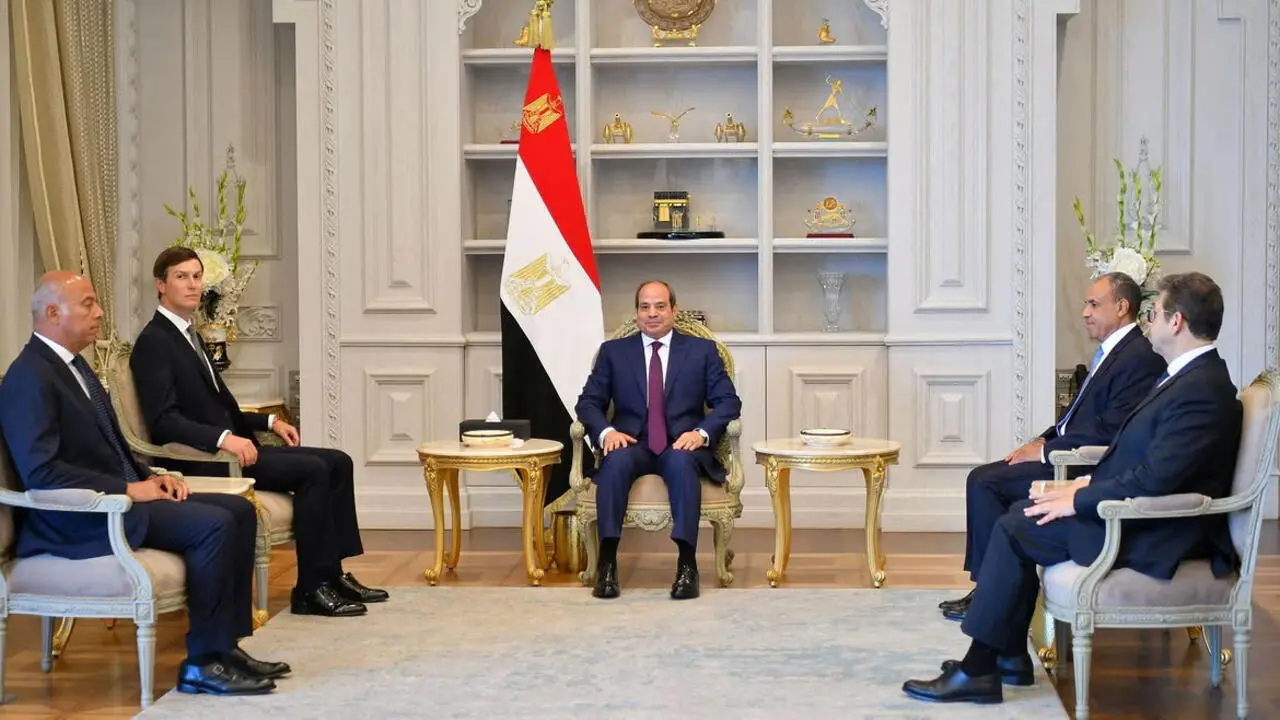
US special envoy Jared Kushner is scheduled to meet Israeli Prime Minister Benjamin Netanyahu on Monday in an effort to advance the American-sponsored peace plan for Gaza. The high-stakes meeting comes just one day after Kushner held talks with Hamas leadership in Egypt, marking an intensive push by Washington to break the deadlock that has stalled the fragile ceasefire and the second phase of the plan.
Kushner, who is also the son-in-law of former US President Donald Trump, has taken a leading role in Middle East diplomacy in recent years. Sunday's meeting with Hamas officials took place in El-Alamein, Egypt, and included discussions on the disarmament of the Islamist movement, which remains one of the most contentious issues in the entire negotiation process. According to sources who spoke on condition of anonymity, Kushner stressed the need for credible measures that would be transparent and verifiable, adding that “Gaza will never again be a source of terror for Israel.”
The American initiative, first presented to the parties earlier this summer, is designed to end the cycle of violence and establish a long-term framework for Gaza's future. The plan's second stage calls for the disarmament of Hamas, the withdrawal of Israeli troops from the territory, and the beginning of reconstruction efforts. While Hamas has formally agreed to the roadmap, Netanyahu's government has expressed serious reservations, insisting on what officials describe as the complete dismantlement of Hamas's military capacity as a precondition for any lasting arrangement.
Diplomatic momentum and regional rivalries
Kushner's shuttle diplomacy comes against a backdrop of intense diplomatic activity across the region. Egypt, which has historically served as a mediator between Israel and Hamas, has shown renewed commitment to brokering a settlement. Egyptian President Abdel Fattah al-Sissi hosted Kushner in El-Alamein, a Mediterranean coastal city, before the US envoy crossed into Israel. Analysts suggest Egypt's role is seen as vital because of its unique ability to communicate with all parties, including Hamas and other Palestinian factions.
Qatar and the United Arab Emirates have also been involved in the broader peace discussions, with Emirati investment in Gaza's reconstruction being seen as a key incentive for making progress. However, the political landscape in the region remains fractured. The Palestinian Authority, which has a separate peace process with Israel and is often at odds with Hamas, watches nervously as the US engages directly with its rival. Any agreement that legitimizes Hamas might weaken the Authority's own claims to represent the Palestinian people, yet a failure to reach a deal would still leave the Strip under Hamas governance without a pathway to stability.
The Israeli security establishment is split on how to deal with the present situation. Some retired generals see an opportunity in the current plan, arguing that a staged disarmament process could gradually reduce the threat posed by Hamas's tunnels, rockets, and armed wing. These security voices believe that the key is to create a viable alternative to Hamas control, through the Palestinian Authority or a repurposed civil administrator, before disarmament can be fully implemented. Others take a far more skeptical line and caution against giving away diplomatic recognition without concrete, observable gains on the ground.
Netanyahu's official position has remained rigid. Over the past week, he told his cabinet that Israel cannot accept a proposal that does not include an explicit commitment to the physical disarmament of Hamas, particularly in terms of heavy weapons and long-range missile capabilities. In his view, the American draft's language is ambiguous when it comes to the strict verification mechanisms that would guarantee that disarmed Hamas cannot quickly reassert its military strength.
Hamas's evolving strategy
For Hamas, the decision to accept the American roadmap in late July was a significant shift. For years, the group had refused to recognize Israel or to accept a negotiated settlement that required it to give up its weapons. Its leadership, however, appears to have calculated that years of blockade, repeated rounds of conflict, and catastrophic humanitarian conditions in Gaza have eroded the benefits of its own military posture. In recent statements, senior Hamas officials have avoided direct references to laying down arms and instead framed their acceptance in terms of “statecraft” and “national responsibility.”
Nevertheless, this flexibility is not without its limits. The movement's military wing, known as the Izz ad-Din al-Qassam Brigades, is deeply entrenched in Gaza's society and its tunnel networks, weapons caches, and personnel. Disarming such an organization in a matter of months would be a massive undertaking that has historically proven impossible in comparable conflicts around the world. Experts point out that international peace missions have generally paired disarmament with economic incentives, governance reform, and a credible security sector that offers former fighters a path to return to civilian life. In Gaza, all of these accompanying measures remain highly uncertain.
International law and human rights groups have also weighed in. Many organizations have argued that any disarmament plan must include safeguards to ensure the safety of Gaza’s civilian population, which has suffered enormously under the repeated conflicts. Reconstruction and humanitarian access, particularly for medical supplies, food, and water, are seen as essential components of a sustainable agreement. More than two million people live in the Strip, most displaced at least once during the recent war, and their needs cannot be postponed indefinitely.
How the meeting might unfold
Monday's meeting is expected to take place in Jerusalem, either in the Prime Minister's office or another secure government facility. Kushner is likely to bring a revised addendum to the plan, attempting to address Israel's concerns about verification and enforcement mechanisms. According to diplomatic sources, the American delegation has been working for days on technical arrangements that would involve a multinational monitoring force at checkpoints and weapons storage sites, possibly including elements from Egypt, Jordan, and a small contingent of US military personnel as observers.
But Netanyahu faces strong pressure from his own ruling coalition. His government includes right-wing parties that have historically opposed any concessions to Hamas and have called for continued Israeli military operations to maintain security control over Gaza. Many MKs have stated that the only acceptable peace plan is one that utterly eliminates Hamas as a military entity. This means that Netanyahu will enter the meeting with very limited political room to maneuver. He might choose to delay a final answer and ask for further security guarantees.
Kushner, who was a key architect of the earlier Abraham Accords that normalized relations between Israel and several Arab states, would view a successful Gaza agreement as the capstone of his diplomatic legacy. But failure would certainly complicate the broader regional integration process. Several Gulf countries have conditioned their further involvement with Israel on the successful resolution of the Palestinian issue, and a return to all-out war would make any grand normalization plans moot.
Geo-political consequences
The outcome of these talks could affect not only Gaza but the entire Middle East. Iran, which has historically supported Hamas in various capacities, is watching the situation closely. From Tehran's perspective, an Israeli-American success in Gaza would reduce the pressure on Israel and increase the risk of isolation for Iranian-backed groups. Sponsorship of Palestinian factions has always been a card in Iran's regional playbook, especially when it comes to building alliances to counter Israeli and Saudi influence. There is little doubt that Iran has an interest in seeing the plan fail or at least stall, but direct interference might also backfire by rallying international support against Tehran.
Egypt, for its part, has a strong interest in preventing Hamas from retaining a military role in the Sinai Peninsula, where a fragile truce between Israel and various militias has held for years. Cairo fears that any new conflict in Gaza could spill over across its border, destabilizing the restructured Egyptian security forces and undermining its economic recovery. That is one of the reasons that President Sissi is investing personal diplomatic prestige in this negotiation.
Jordan, another crucial neighbor, also stands to benefit from a settlement. The Hashemite Kingdom hosts a very large Palestinian refugee population, and previous conflicts in Gaza have produced acute political tensions inside Jordan. Stabilizing Gaza would ease the refugee crisis and curtail domestic criticism of Amman’s peace treaty with Israel.
The humanitarian situation in Gaza remains dire. According to UN and NGO reports, much of the territory is still in ruins, with entire neighborhoods turned to rubble and basic infrastructure like electricity and potable water nearly non-existent. Health services are overwhelmed, schools are either damaged or used as shelters for displaced people, and unemployment is rampant. Any political agreement that is not accompanied by a massive infusion of reconstruction funding is likely to be seen as hollow. International donors have met several times at ministerial level, but pledges can only be disbursed once a credible government and security framework are in place.
All parties now look to Monday's meeting with a mix of hope and skepticism. Israeli media report that residents of the southern areas near Gaza are wary of yet another diplomatic initiative that seems to promise much and deliver little. Some have argued that the best way to prevent future attacks is the complete closure of the border and a return to the old defensive posture. Others, however, have come to realize that perpetual siege and sporadic military operations will not bring security in the long term. A senior Israeli security official, speaking to reporters off camera, said that "peace requires compromise, but every compromise in this region is measured in blood.” The official emphasized that any plan must also be accepted by the Palestinian people as a whole, or it will fail.
Meanwhile, Gaza's newly emerging civil committees and youth groups are organizing small protests and awareness campaigns to insist that the reconstruction proceeds according to the needs of the communities, not just the goals of donors. Women-led cooperatives, which have grown in influence in recent years, are calling for a substantial role in governance and the management of reconstruction, a point that many international diplomats have welcomed as a sign of a maturing civil society. The question remains whether the political leaders on all sides will embrace these voices, or continue to pursue exclusively top-down agreements.
As Kushner sits down with Netanyahu, the world will be watching for concrete signs of movement. Behind the scenes, the US administration is coordinating with Egypt and Qatar to set up a follow-up conference in Cairo, where the next phase of humanitarian aid and reconstruction projects would be announced. But these arrangements will only materialize if the American emissary can overcome the very deeply rooted objections and suspicions that have built up over decades. The meeting may be the decisive turning point, or it may become yet another dead end in the long and tragic history of the Israeli-Palestinian conflict.
Source: France 24 News