

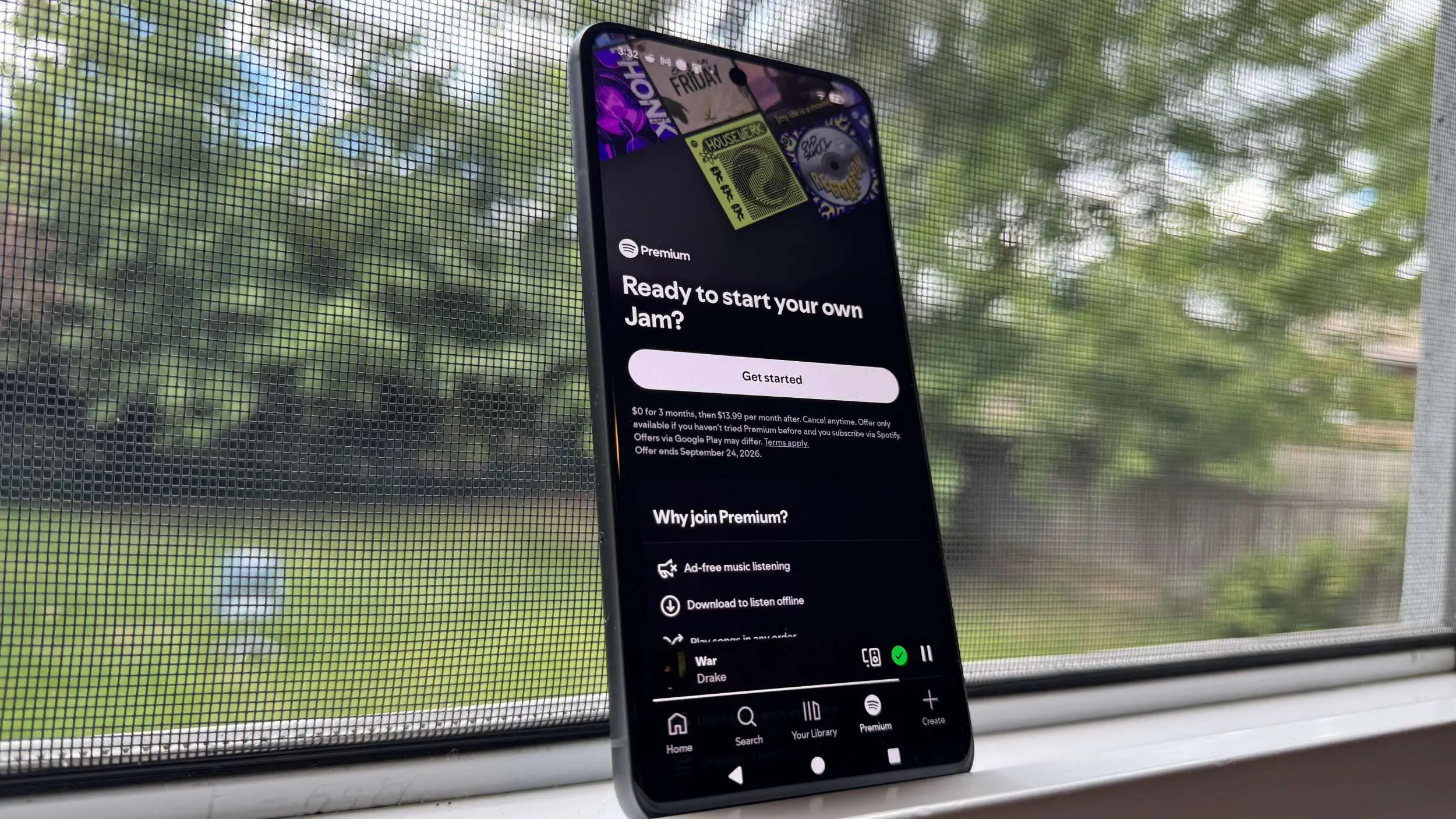
Spotify’s Jam feature has been a hit among music lovers who want to build shared playlists in real time. Since its launch in September 2023, Jam has allowed up to 32 people to add songs and vote on what plays next. But there has always been one significant catch: only Premium subscribers could host a Jam. Now, new signs buried in the Spotify Android app suggest that this restriction could soon be relaxed. Free users may finally get the chance to host their own Jams, though the experience would likely come with several limitations that also affect Premium participants.
What is Spotify Jam?
Jam is a fully collaborative real-time playlist designed for group listening sessions. The feature was introduced in September 2023 as a natural extension of Spotify’s Blend, which let two people merge their music tastes into a single playlist. Jam took that concept further by allowing a much larger group to interact with a shared queue. Anyone who joins a Jam can see what’s playing, add songs to the queue, and reorder tracks, depending on the host’s settings. It quickly became one of Spotify’s most praised social features, especially for parties, road trips, and group study sessions.
For the past three years, however, the feature has operated under a clear divide. Joining and participating in a Jam has always been free. If a friend invites you to their Jam, you don’t need a paid subscription to add songs or see the track list. But starting a Jam and controlling the experience has required Spotify Premium. The upsell message was straightforward: “Get Premium to start your own Jam and play any song, any time.” That paywall made sense from a business perspective, but it also frustrated free-tier users who wanted to host their own listening parties.
The code change that hints at the shift
In the latest version of the Spotify Android app, version 9.1.82.19, a teardown of the application files revealed altered wording in several key strings. These strings are the text snippets that appear in the interface when a free user attempts to do something reserved for Premium subscribers. Earlier versions of the app used messages like “Get Premium to start your own Jam and skip as much as you want.” The new strings, however, remove the direct reference to starting a Jam. Instead, they focus on the loss of control once a Jam is already underway. For example, one updated string reads, “Get Premium to take full control over what plays next.” Another says, “Get Premium to skip as much as you want.”
This subtle wording change may not seem dramatic at first, but it strongly suggests that the act of hosting a Jam is no longer being framed as a Premium-exclusive action. Instead, the paywall text is now oriented around the premium benefits within a Jam, such as full control and unlimited skips. That aligns with a scenario where free users can host Jams, but the experience is intentionally more limited than what Premium hosts can offer.
Additional strings reveal limitations for free-hosted Jams
The evidence becomes even more compelling when looking at other code strings found in the same app version. Spotify appears to have added messages that describe what happens when a Jam is hosted by someone on the free plan. One string reads, “You can’t skip songs in this Jam anymore as the host is on the free plan.” Another reads, “Songs are now playing in a random order as the host is on the free plan.” A third says, “You can’t queue songs in this Jam anymore as the host is on the free plan.”
These messages were not present in previous versions of the Spotify app. Their appearance suggests that Spotify is actively working on a system where free-tier users can initiate Jams, but the overall experience will be constrained by the limitations of the free plan. The fact that the messages specifically mention the host being on a free plan implies that these restrictions apply to everyone in the Jam, regardless of their own subscription status.
What a free-hosted Jam would look like
If Spotify does roll out this change, free users will finally be able to start their own Jams. However, the experience will be noticeably different from a Premium-hosted Jam. Based on the leaked strings, a Jam hosted by a free user would force the playlist into shuffle mode. Instead of allowing listeners to play songs in any order, all tracks would play in a random sequence. This mirrors the standard free-tier experience on Spotify, where on-demand playback is not available and users must rely on shuffle.
Skipping would also be severely limited. Free Spotify users already face skip limits when listening on mobile, and those same restrictions would carry over to any Jam they host. This would affect Premium participants too, which could be confusing for subscribers who are accustomed to unlimited skips in their own listening sessions. The queue would also be capped or disabled entirely. In a normal Jam, participants can add songs and reorder the queue. But in a free-hosted Jam, the queue feature would be locked, preventing anyone from contributing to the playlist order.
For Premium subscribers, this could be a frustrating experience. Imagine joining a friend’s Jam, expecting the usual collaborative freedom, only to be stuck in shuffle mode with a limited number of skips because the host is not paying for Premium. Spotify appears to be aware of this potential friction. The app strings include messages like “Songs are playing in a random order. Play in any order with Premium.” This suggests that the company would use these limitations as a subtle upsell, encouraging participants to upgrade even though they are not the host.
Why Spotify might be lowering the paywall
Spotify has long used its free tier as a way to attract users and then convert them to Premium through carefully placed limitations. Allowing free users to host Jams could be a natural evolution of that strategy. By giving free users a taste of the social and interactive aspects of the platform, Spotify may create more reasons for them to upgrade. The restriction on queueing and skips might make the experience just limited enough to drive home the value of a paid subscription.
There is also a social context to consider. Jam is turning three years old in September 2026. The timing of this change could be linked to a milestone celebration or a broader push to make social features more accessible. Spotify has been competing with other music platforms that have introduced their own collaborative listening tools. By expanding Jam access, Spotify could position itself as the most socially inclusive streaming service, even for users who are not ready to pay.
The change would also align with Spotify’s efforts to grow its ad-supported user base. Free users who host Jams may spend more time on the app, leading to more ad impressions. The trade-off is that the experience is degraded enough to encourage conversions. This is a classic freemium model, but applying it to a social feature brings a new twist: the limitations are not just felt by the free user, but by everyone who joins their session. That collective pressure could be a powerful driver for Premium adoption.
The potential impact on the Spotify community
For many users, the ability to host a Jam without Premium would be a welcome change. College students, casual listeners, and users in regions where Premium is expensive have long felt locked out of one of Spotify’s most interactive features. Removing the host requirement would democratize the experience and allow more people to organize listening sessions with friends and family. Even with shuffle and skip limitations, the ability to gather a group and share songs in real time adds significant value to the free tier.
However, the limitations could create awkward social dynamics. If a Premium user joins a Jam hosted by a free user, they might feel like their subscription benefits are being taken away. Spotify’s messaging would need to clarify that the host’s plan determines the Jam’s restrictions. Otherwise, it could lead to confusion and frustration. Some users may decide to avoid free-hosted Jams altogether if the experience is too restrictive.
What would need to happen for the rollout
It is important to note that the strings found in an app teardown do not guarantee that this feature will be released. Spotify regularly tests new ideas and changes its mind. Even if the company does launch free-hosted Jams, the final implementation could look different from what the code strings suggest. The feature would likely be controlled by server-side flags, meaning Spotify could silently enable it for a small group of users before a broader rollout. There is also the possibility that the company abandons the idea entirely if it does not perform well in testing.
Spotify has a history of experimenting with social features and then refining them over time. The company introduced Jam as a Premium-hosted experience, and it has slowly expanded related capabilities. For now, the code changes serve as a strong indication that the company is at least considering making Jams accessible to free users. Whether that becomes a public reality depends on factors such as advertising revenue, user feedback, and the overall product roadmap.
As with all early teardowns, the discovery of these strings is just a glimpse into Spotify’s development process. The feature may arrive in the coming months, or it may never see the light of day. But the altered wording and new limitation messages suggest that Spotify is seriously thinking about breaking down the Premium paywall for Jam hosting. If the feature does launch, the music streaming landscape will likely see a new wave of free-tier group listening sessions, complete with shuffle-only playback and limited skips. Whether that trade-off wins over users remains to be seen.
Source: Android Authority News