

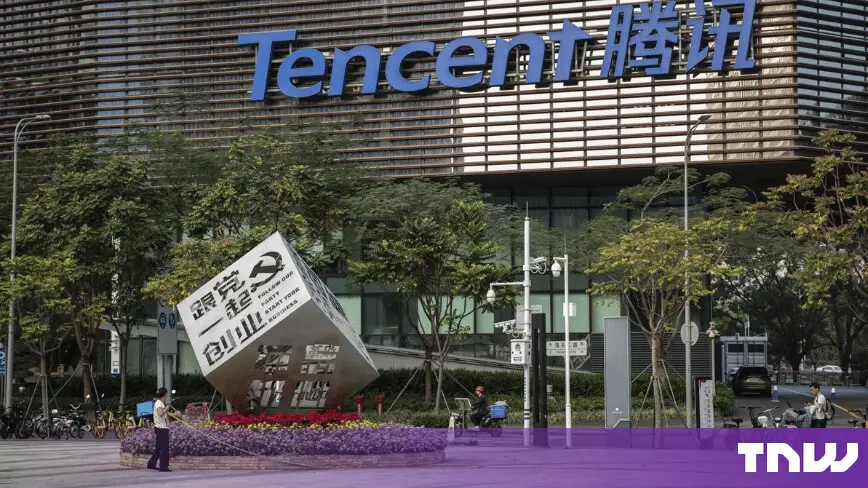
Tencent's second-quarter earnings sent a clear signal: the company is willing to spend its profits on artificial-intelligence infrastructure and ask investors to be patient. The Chinese internet giant reported revenue of 204.8bn yuan ($30.4bn), up 11% from a year earlier and slightly ahead of analyst forecasts. Net profit, however, came in at 56bn yuan, short of the 61.8bn yuan that analysts had expected.
The gap between revenue and profit is explained by one number: capital expenditure surged 176% year on year to 52.8bn yuan, about $7.8bn. Compared with the previous quarter, capex rose 65%. The acceleration is even more striking than the annual comparison suggests, and it turned Tencent's free cash flow negative.
Free cash flow swung to an outflow of 13.8bn yuan in the June quarter, according to Bloomberg data. In other words, the cash generated by Tencent's sprawling operations—WeChat, gaming, advertising and cloud—was not enough to cover the infrastructure bill and other outgoings. For a company that has been a cash-generation machine for two decades, that is a notable departure.
Key facts at a glance
- Revenue: 204.8bn yuan ($30.4bn), up 11% year on year
- Net profit: 56bn yuan, below the 61.8bn yuan analyst consensus
- Capital expenditure: 52.8bn yuan ($7.8bn), up 176% year on year and 65% quarter on quarter
- Free cash flow: -13.8bn yuan
- Operating costs: up 22.6%; adjusted net income: 68.4bn yuan, up 9%
- Domestic games: up 17% to 47.3bn yuan; marketing services: up 22% to 43.6bn yuan
- WeChat and Weixin monthly users: 1.44bn, up 2%; QQ Mobile: 520m, down 2%
- Stock: down 26% in 2025; Prosus fell 6% on the day
The quarter in two figures
The 176% jump in capital expenditure is the headline figure, but it only tells part of the story. The sequential increase of 65% shows how quickly Tencent has stepped up spending. Most coverage of the earnings release focused on one or the other; together they describe a company in the middle of a massive shift.
Operating costs climbed 22.6% in the quarter, according to Bloomberg Intelligence. That rise weighed on profitability. Adjusted operating profit growth slowed to 9.2%, while adjusted net income reached 68.4bn yuan, up 9% and roughly in line with expectations. The underlying business is still growing, but a larger share of that growth is being consumed by expenses related to compute and AI development.
Tencent has long been known for its ability to convert user engagement into advertising and gaming revenue. Its cash pile has historically supported buybacks and dividends. This quarter's negative free cash flow is a reminder that even the most reliable cash generators can turn into heavy investors when a new technology wave arrives. The company is not alone; major technology groups around the world are in the middle of a similar AI-driven capex cycle.
Why Tencent is spending so much
Tencent is building out AI models and the data centers to run them. The company has said its investment in AI products will double this year, but unlike Alibaba, which has pledged more than $50bn over three years for AI infrastructure, Tencent has not set a multiyear capital expenditure target. That leaves investors guessing how long the spending spree will last.
Management used the earnings call to address those concerns. Chief strategy officer James Mitchell said Tencent could achieve a 'decent return in an immediate timeframe' by renting out all of its compute capacity. Instead, the company is choosing to build its own models in pursuit of what he called 'superior economic returns over the longer term'.
President Martin Lau framed the same point as a floor. In a worst-case scenario, he said, the infrastructure could be rented out at cost recovery. 'There is also clear downside protection,' Lau told analysts. The implication is that Tencent's massive compute bill will not be wasted, even if its AI models fail to deliver market-leading breakthroughs.
The neocloud fallback
Read that argument literally: the downside case for a quarterly $7.8bn compute bill is that Tencent becomes a neocloud—a company that rents out its computing power to others. That is a real business, but it is very different from the Tencent that sells game skins and advertising. The fallback plan may reassure investors about the balance sheet, but it also highlights how far the company is willing to stretch its identity in the AI race.
Tencent's willingness to discuss renting out compute is unusual. In previous years, its earnings calls focused on user growth, content licenses and gaming approvals. The new language reflects a company that has to answer to investors who are simultaneously worried about AI disruption and about spending discipline. By presenting a clear floor for the value of its infrastructure, management is trying to reconcile those two concerns.
Pressure from competitors
Tencent is not the only Chinese tech company pouring money into AI. Alibaba has committed over $50bn to AI infrastructure over three years. Moonshot AI's Kimi K3 model has matched industry leaders on fewer resources. Alibaba's Qwen3.8-Max topped several industry benchmarks. DeepSeek, meanwhile, has become a major force in open-source AI.
Tencent has hedged its bets. It joined DeepSeek's debut funding round and wired DeepSeek's V4 model across its own products. But Tencent is the only one of China's biggest technology names without a flagship frontier model. Its Hy3 model shipped last month, and a larger successor, Hy4, is expected later this year. Whether Hy4 can compete with the best from DeepSeek and Moonshot will be the key test of Tencent's strategy.
The absence of a flagship model is a competitive problem, but it is not yet an existential one. Tencent owns distribution through WeChat, which has more than a billion users. It can embed AI assistants into the most-used messaging app in China. That gives it a route to market that pure AI startups cannot match. The question is whether the model itself is good enough to take advantage of that distribution.
The market's mixed reaction
Investors have not been kind to Tencent this year. The stock is down 26% in 2025, wiping out roughly $170bn in market value. Part of the decline reflects concern that the spending is reckless. Part of it reflects the opposite: that Tencent is not spending enough or not committing to a clear AI roadmap. The market has punished the company both ways.
The negative reaction extended to Europe. Prosus, the Amsterdam-listed group that holds a large Tencent stake, fell 6% on the day. A quarterly report from Shenzhen is a European market event because of that shareholding, even though the link is rarely visible on ordinary days.
What is actually working
Behind the capex story, Tencent's operating business had a solid quarter. Domestic games revenue rose 17% to 47.3bn yuan, boosted by Delta Force and Valorant. That was a sharp acceleration from 6% growth in the first quarter. Marketing services revenue climbed 22% to 43.6bn yuan, which Tencent credits to AI-driven advertising targeting. Cloud revenue grew in the low twenties, and the company raised prices.
International games revenue slipped 0.8% due to currency effects, or grew 4% in constant currency terms. WeChat and Weixin reached 1.44 billion monthly active users, up 2% from the prior year. QQ Mobile fell 2% to 520 million. Tencent has also been cutting studio investments in Japan and trimming staff at LightSpeed and TiMi, a sign that the company is tightening costs outside its AI priorities.
Its own AI products are early but not negligible. WorkBuddy is now China's most popular AI office tool, with 21 million monthly visits in June. Xiaowei, an assistant inside WeChat, remains in a small-scale prototype test.
Hardware and memory
The AI push has also turned Tencent into a major buyer of hardware. The company struck a reported $3bn memory deal with CXMT, a Chinese memory chipmaker. Founder Pony Ma told analysts that Tencent is 'making substantial progress toward building a new AI-empowered Tencent'.
The spending appears in the cash flow statement and in the income statement. Free cash flow—often cited as a measure of a company's ability to fund shareholder returns—is now negative. That means Tencent is borrowing or using existing cash reserves to pay for its expansion. For a company that has routinely generated tens of billions in free cash flow, this is a turning point.
The stakes for Hy4
Tencent has promised that Hy4 will arrive later this year. The model will need to prove that the compute bill is buying more than a seat at someone else's breakthrough. If Hy4 competes with the best from DeepSeek and Moonshot, the spending may look like a necessary investment. If not, Tencent will have to rely on the neocloud fallback or wait for another generation of models.
The company's messaging to investors is patient, and its price action has been painful. But the strategic direction is unmistakable. After two decades of turning online activity into cash, Tencent is now turning cash into compute. The coming quarter, and the release of Hy4, will show whether that bet pays off.