

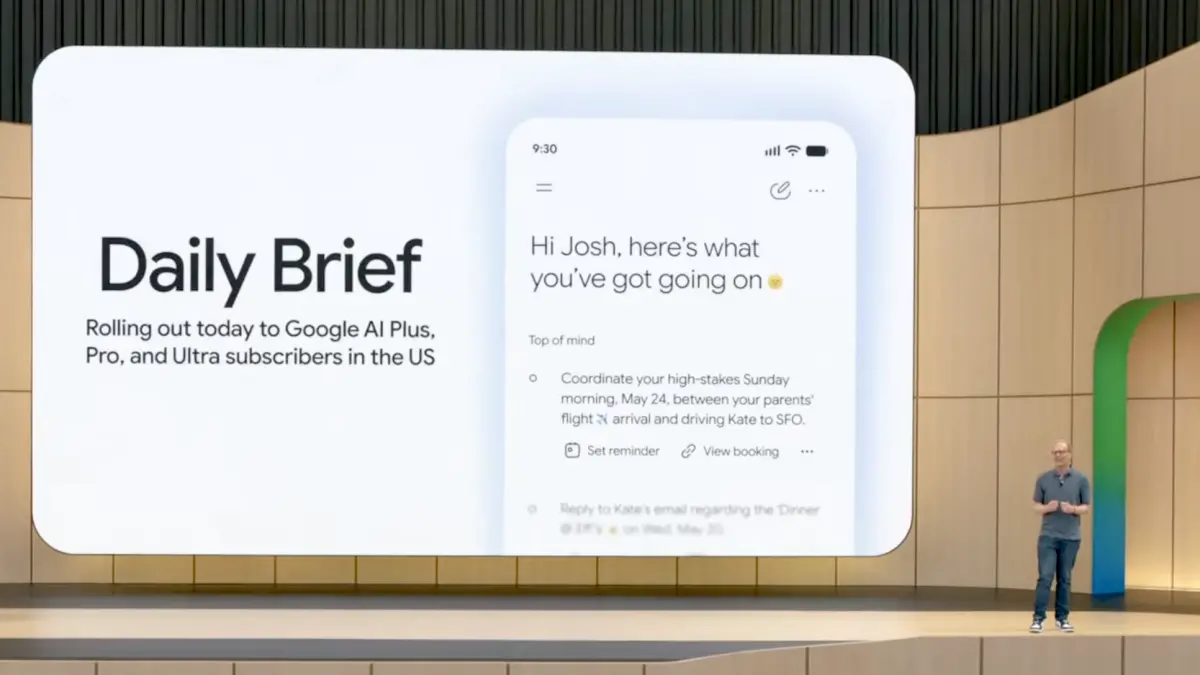
Google is deepening its commitment to artificial intelligence with the development of a new 'Daily Brief' feature designed to provide users with personalized, AI-curated summaries of news, weather, calendar events, and more. While the company has not officially announced the product, recent leaks and advancements in its AI models—including the Gemini Omni world model and Gemini 3.5 Flash—strongly suggest that a daily briefing assistant is on the horizon.
What We Know About the AI-Driven Daily Brief
According to internal documents and reports from sources familiar with the project, Google's Daily Brief will be a central component of its broader effort to embed generative AI into everyday life. Unlike a simple news aggregation tool, the brief will learn from user preferences, browsing history, and location to deliver a highly tailored audio or text summary each morning. Users will be able to set topics of interest, such as technology, politics, or sports, and the system will use Gemini models to synthesize information from across the web, including Google Search, YouTube, and news partners.
The brief is expected to be available across multiple devices, but its integration with the upcoming Android XR smart glasses—developed in partnership with Samsung—has generated particular excitement. The glasses, unveiled in May 2026 but still without a name or price, promise an always-available, hands-free interface where the Daily Brief could be played as an audio stream or displayed as a transparent overlay. This would allow users to receive updates while commuting, exercising, or even during work, without needing to pull out a phone.
The Technology Behind the Brief: Gemini Omni and Gemini 3.5 Flash
At the heart of the Daily Brief is Google's Gemini family of large language models. On May 19, 2026, Google launched Gemini 3.5 Flash, a new model designed for speed and efficiency. Unlike its larger siblings, Flash is optimized for real-time tasks with low latency, making it ideal for daily brief generation. Users can already try Gemini 3.5 Flash for free through Google's AI test kitchen, and early adopters report that it can process and summarize hundreds of articles in seconds, while also generating natural-sounding audio using text-to-speech.
Even more ambitious is Gemini Omni, a world model that goes beyond language to understand video, images, and 3D environments. The first model in this family, Gemini Omni Flash, also rolled out in May 2026. Capable of advanced AI video generation and spatial reasoning, Omni Flash could power features like visual summaries—for instance, generating a short video recap of the day's top stories—or augmenting the daily brief with interactive elements. For example, if a user asks about a news event, the system could display a relevant map or historical timeline on the smart glasses' display.
These models are not just technical demos; Google has made them widely available through its API, and developers are already building applications using them. The Daily Brief would likely be one of the first flagship consumer applications to showcase both models' capabilities in tandem.
Historical Context: From Google Now to AI Assistants
Google's interest in daily briefings is not new. The company once offered Google Now (2012), which provided predictive cards with weather, traffic, and calendar events. Google Now was praised for its contextual awareness but later folded into the Google Assistant. Assistant, in turn, introduced 'My Day' routines that read out schedule and news. However, these features were rule-based and lacked the generative, conversational depth that modern AI enables.
With the rise of ChatGPT and other generative AI chatbots, Google has been racing to catch up. Bard (now rebranded to Gemini) was launched in 2023, and subsequent updates have added image generation, multimodal understanding, and deeper integration with Google services. The Daily Brief represents a natural evolution: instead of users having to ask for summaries, the system proactively delivers them in a format that feels organic and intelligent.
Competitors are also moving in this direction. Apple is rumored to be working on a similar 'Personalized News Digest' powered by its own large language models, and Microsoft's Copilot offers a 'Daily Briefing' feature in Microsoft 365. However, Google's advantage lies in its vast ecosystem of data—Search, Gmail, Maps, YouTube, and Google News—which can be fed into the AI to create a truly comprehensive update. Privacy implications are significant, and Google has stated that any such feature will have strict optionality and on-device AI components to minimize data centralization.
Integration with Android XR Smart Glasses
The partnership with Samsung on Android XR smart glasses is a critical piece of the puzzle. Billed as 'intelligent eyewear,' the glasses are expected to arrive later in 2026 with a focus on everyday use. They will feature a lightweight design, hands-free voice control, and a transparent display for notifications and overlays. While the full specifications are not yet public, references in developer kits suggest they will support persistent AI assistant interactions, much like Meta's Ray-Ban Stories but with Google's AI backend.
Imagine waking up, putting on the glasses, and hearing your personalized Daily Brief read aloud. The AI will summarize the news, remind you of appointments, suggest a route to work based on traffic, and even recommend a podcast about a topic you've been reading about. If a notification seems urgent, the glasses can buzz discreetly. All of this happens without a screen in your face—the brief can be delivered as audio or as small text overlays that appear only when you glance at them.
Beyond the daily brief, the glasses are expected to support real-time translation, object recognition, and navigation, all powered by Gemini. But the brief feature could be the killer app that convinces consumers to adopt smart glasses, following the pattern of smartphones where the 'morning news' became a staple.
Practical Applications and User Experience
Users will be able to customize their Daily Brief in depth. For instance, a tech journalist might want updates on product launches and industry analysis, while a parent might prefer school news, local events, and weather. The system can learn from user feedback: if a user skips certain topics, they will be deprioritized. Users can also set a preferred time for the brief (e.g., 7:00 AM) and choose between a 3-minute summary or a longer, in-depth version.
Because it uses Gemini 3.5 Flash, the brief can be generated on-device for privacy, but cloud processing will be used for complex queries. Google has been tightening security around its AI services, and the Daily Brief will likely require opt-in for using data across services. A public beta is expected later this year.
Developers are already experimenting with similar concepts. Third-party apps that combine Google Calendar, news APIs, and Gemini's API have appeared, but official integration will be seamless and likely free with a Google account. A paid tier for ad-free or advanced features may launch eventually, but the basic brief is expected to be ad-supported.
The announcement comes at a time when trust in news media is declining, and personalization algorithms are often criticized for creating filter bubbles. Google has stated that the Daily Brief will include a variety of reputable sources and will highlight stories from different perspectives, including a 'balanced' mode that shows multiple sides of a controversial issue. This is part of Google's broader effort to combat misinformation while still offering tailored content.
In summary, the AI-driven Daily Brief is emblematic of Google's strategy to make AI ambient, proactive, and useful without being intrusive. With the combination of powerful new models like Gemini 3.5 Flash and Omni, plus next-generation hardware like Android XR glasses, Google is positioning itself to redefine how we consume information at the start of each day. The race to own the morning routine is accelerating, and Google appears to have a strong hand.
Source: Mashable News