

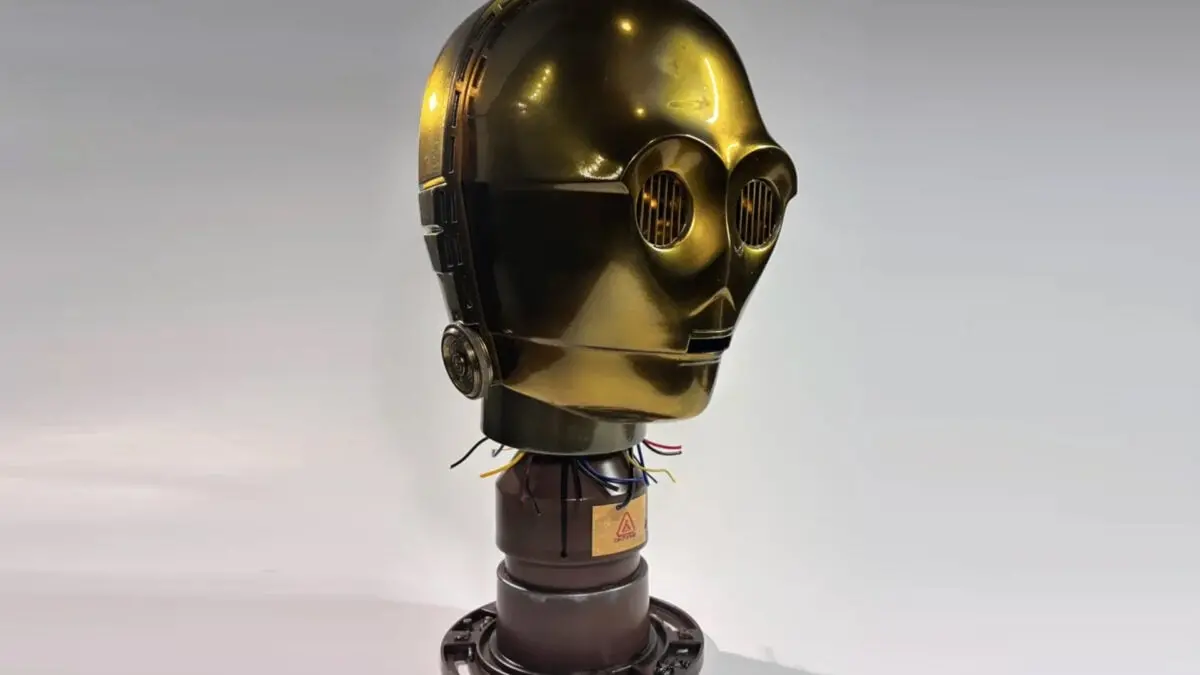
May the fourth be with you, and all that. For Star Wars Day, we turn our attention to one of the galaxy's most verbose and prissy droids: C-3PO. The golden protocol droid, voiced by Anthony Daniels, has been a staple of the franchise since 1977. While R2-D2 steals scenes with beeps and whistles, Threepio's melodramatic commentary and impeccable manners have made him both a source of comic relief and a surprisingly complex character. Now, thanks to a student at Chapman University, you can build your own C-3PO head that not only looks the part but can hold a conversation with you—all powered by modern artificial intelligence.
Samuel Potozkin, a student based in Orange County, California, recently posted a video detailing his journey to create a fully functional, conversational C-3PO head. The project combines 3D printing, electronics, and AI to create a device that responds to voice input with authentic-sounding Threepio dialogue. The head's speech capabilities are driven by a custom large language model (LLM) that has been fine-tuned to embody the droid's famously fussy personality. According to Potozkin, the pipeline is elegantly simple: a microphone captures your speech, which is sent to a Raspberry Pi 5 mini-computer. The Pi runs a real-time speech-to-text converter, then forwards the transcribed text to the LLM as a prompt. The model generates a response, which is then processed through a text-to-speech system designed to emulate C-3PO's distinctive vocal delivery—complete with that metallic, reverb-heavy tone.
This project comes at a time when Star Wars props and memorabilia are fetching astronomical prices. Just last month, the original C-3PO head prop used in The Empire Strikes Back sold at auction for over $1 million, making it one of the most expensive pieces of Star Wars memorabilia ever sold. That particular head was separated from its owner's body during the iconic Cloud City sequence, when a disoriented Threepio wanders through the wrong door and gets blasted apart. For fans who cannot afford a million-dollar movie prop, Potozkin's DIY approach offers a much more accessible way to bring a piece of the galaxy far, far away into their living room.
The Technology Behind the Chatbot
At the heart of the project is a Raspberry Pi 5, a credit-card-sized computer that handles the heavy lifting of speech recognition and text generation. The Pi runs a lightweight speech-to-text engine that converts the user's spoken words into text in near real time. That text is then sent to a custom large language model. While Potozkin has not disclosed the exact base model he used, it is likely based on one of the open-source LLMs such as LLaMA or Mistral, fine-tuned on a dataset of C-3PO dialogue from the films and expanded content. The fine-tuning ensures that the responses feel authentic—pedantic, slightly condescending, and full of dramatic flair.
The text-to-speech (TTS) component is where the magic truly happens. Potozkin discovered early on that off-the-shelf TTS systems did not produce the metallic, resonant quality associated with C-3PO's voice. To address this, he applied a series of audio post-processing effects. In his GitHub documentation, he describes a process that sounds more like a guitarist's pedalboard than a typical voice pipeline: a short delay line creates tightly spaced temporal reflections, simulating the sound of the droid's hollow head; a chorus effect slightly modulates the time and pitch of duplicated signal paths, producing layered vocal resonance; and a touch of reverb adds depth. The result is a voice that, while not a perfect replica, is immediately recognizable as Threepio—especially when emanating from a golden, two-eyed head with a permanently worried expression.
Historical Context: The Voice of C-3PO
Anthony Daniels, the actor who has portrayed C-3PO in every Star Wars film, show, and most video games, developed the voice over decades. In early interviews, he described basing the voice on a combination of British butlers, nervous nellies, and his own sense of exasperation. Daniels's performance has become so iconic that any attempt to replicate it must walk a fine line between homage and parody. Potozkin's AI approach avoids that trap by learning from actual scripted lines, ensuring the tone remains consistent with the character.
Interestingly, the idea of a talking C-3PO prop predates modern AI. In 2015, a Disney theme park Imagineer built a partially functional animatronic C-3PO that could speak a limited set of phrases triggered by remote control. But those systems were scripted and could not respond to novel input. Potozkin's project represents a quantum leap, turning the droid into a conversational agent capable of discussing anything from the likelihood of successful astromech repairs to the impropriety of tracking moisture on one's boots.
DIY Culture and the Future of Character AI
Potozkin is not alone in exploring AI-powered character replicas. Enthusiasts around the world have built similar systems for characters like Kermit the Frog, the Doctor (from Doctor Who), and even historical figures like Abraham Lincoln. The underlying technology is becoming increasingly accessible. Open-source LLMs can be fine-tuned on relatively small datasets, and TTS engines now allow for voice cloning with just a few minutes of audio samples. Potozkin's project, however, stands out for its complete integration of hardware (the 3D-printed head, the Raspberry Pi, the microphone and speaker) and software (the speech pipeline and LLM).
The implications of this technology extend beyond novelties. For museums and theme parks, AI-powered character replicas could offer interactive experiences that adapt to visitors. For educators, a talking historical figure could bring lessons to life. For content creators, the ability to generate authentic-sounding dialogue for characters could streamline scriptwriting. Yet ethical questions remain: who owns the voice of a fictional character? Can a company like Disney claim rights over an AI that sounds like C-3PO? These questions are likely to surface as DIY projects like Potozkin's gain visibility.
Potozkin has published all details of his project on GitHub, including the 3D printing files, circuit diagrams, and software code. He encourages others to build their own heads, tweak the personality parameters of the LLM, and even train the model on different Star Wars characters—imagine an Ewok that explains forestry techniques or a Gonk droid that only says "Gonk." The possibilities are limited only by the builder's ambition.
As Star Wars Day approaches next year, you too could be the proud owner of a talking C-3PO head—one that not only decorates your coffee table but also engages in conversations about the finer points of binary load lifters or the rudeness of certain smugglers. And if you ever tire of Threepio's complaints, you can always reprogram him to sound like an even more talkative protocol droid. After all, as the droid himself might say: "It is a most fortunate coincidence that you have found this article. I shall endeavor to be as helpful as possible, though I must warn you—my patience for organic foolishness has never been particularly robust."
Source: Gizmodo News